Sunday, 1 November 2020

Remembering Mum and Dad: All Soul's Day 1 November 2021


This a re-post from last year.  The sentiments are unchanged and always will be, but I've updated it to take account of the passage of time and the Pandemic.


Forget Hallowe'en.  

Despite all the trick or treating, crazy costumes and horror movies on the telly, here in Poland it's no more than a sideshow.  Thankfully the American obsession with it hasn't reached us, at least not to the same extent.  Indeed, the Catholic Church here, whose priests and nuns provide religious instruction in schools, in a country where First Communion and Confirmation are taken much more seriously than in many places (certainly than back home in Britain) openly and happily denounce Hallowe'en as being Evil, and encourage parents to ignore it and punish kids who join in the fun.  Mind you, they say likewise about the Easter Bunny and Father Christmas.  Which says a lot about the the shape of things here right now.....

No, the big day here is the next day, November 1st.  All Soul's Day.  The old religious festival - that has pagan roots rather than Christian - is the third most important day on the calendar, after Christmas Eve and Good Friday.

------------------------------------------------------------------

Traditionally, people are expected, and indeed are taught from childhood, to remember and pay their respects to their deceased relatives.  This is done by visits to the graves of parents and grandparents, aunties and uncles, brothers and sisters and cousins who have passed away.  Parents take their children, and often travel the length and breadth of Poland to carry out these devotions.  All Soul's Day itself is a religious holiday with shops and businesses closed (their workers are obviously making their own observances).

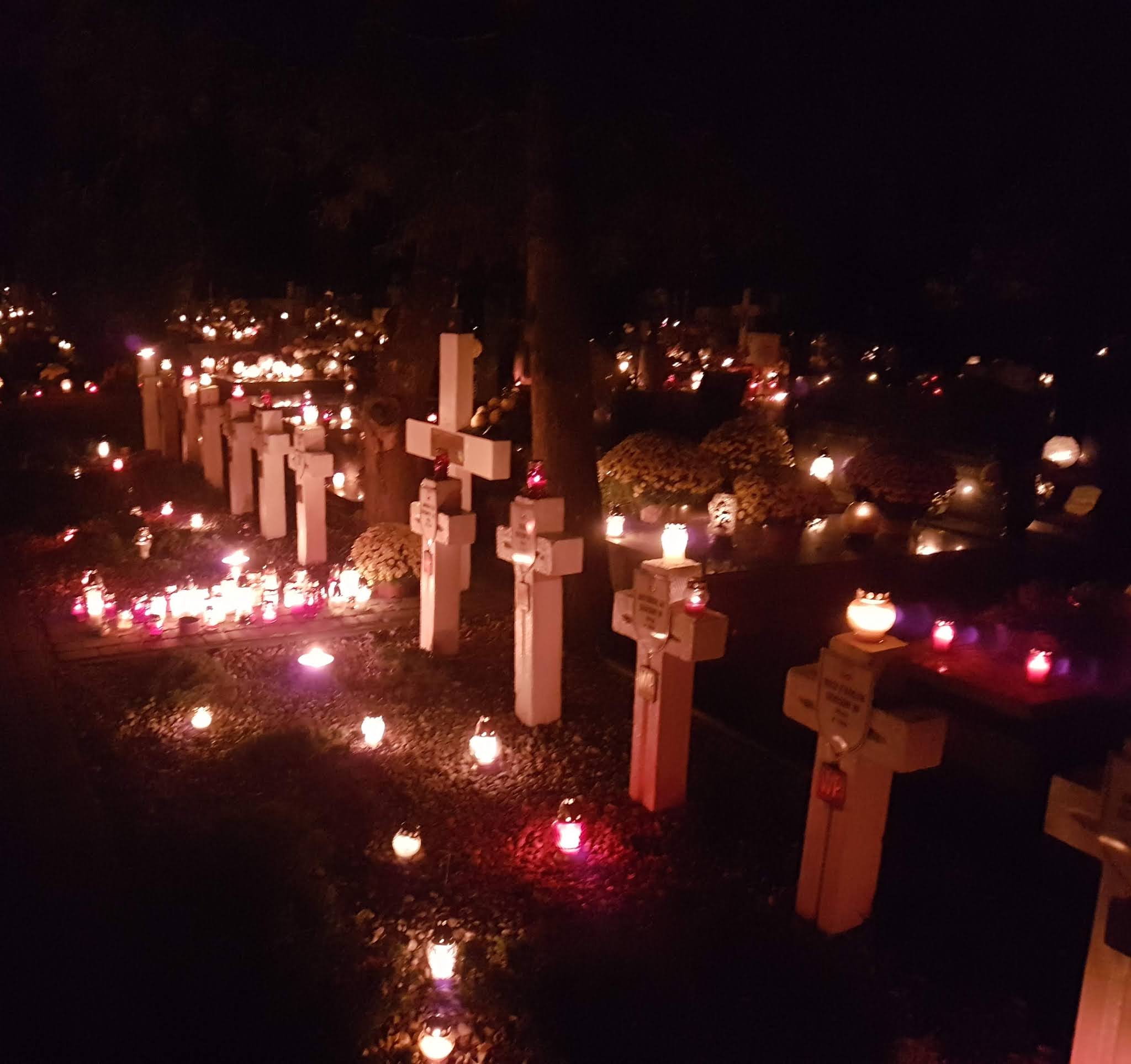
Visitors do not only take flowers, as is the norm in the UK.  Far more predominant are the candles, of varying sizes and in a dazzling array of coloured and clear plastic vases.  Most graves end up with two or three bouquets and at least half a dozen candles.  By the end of the day, even the smallest and darkest cemetery is ablaze with the light from hundreds of candles. But Polish cemeteries, at least the city ones, tend to be huge affairs with thousands of graves spread across many acres, so you're talking tens of thousands of candles.  The light from them can be seen from some distance - I can remember flying in one All Soul's evening under a bright cloudless sky and being able to clearly see the patches of golden light that marked the cemeteries in many towns and cities  that we passed.  It's a beautiful and moving sight.

In fact, the whole event is that.  I don't consider myself in any away devout - I have my own set of beliefs that are a kind of Christianity, that I have come to over a lifetime and that comfort me - and do not belong to any recognised religion.  I was christened Church of England, though my teens attended a non-conformist Baptist chapel and ended up marrying two Catholic girls and attending Mass most Sundays (once the kids came along) but was never confirmed in either of the first two and never converted.  I'm not an atheist, but it would be difficult to classify me as Christian either.

Yet there is something comforting in standing at the various graves of my wife's departed, lighting our candle and placing it carefully amongst the others (we are never the first to arrive), then stepping back for some moments of quiet prayer and contemplation.  When the kids were small, my wife would lead them in some traditional Polish prayers and the kids would join in the genuflection and "Amen" conclusion.  I would listen in silence, as I still do, lost in my own thoughts.


-------------------------------------------------------

Every time I go back home to visit my sisters and sons and their families, I make a pilgrimage to my home town in Kent.  I've watched it change over the years: the High Street changes, more housing, more people, a one way system and traffic lights. But remaining constant are the graveyards in Church Street, the old one-time council estate where I was born.  In one of them my parents share a grave, with a grey marble headstone and edging, gravel base and flower pots.  Compared to some of the huge headstones that dominate Polish graves, its small beer indeed, but of course it means the world to me.


I clean it up, dispose of any old and dead flowers and weeds, give it a sweep, change the pot water and place my own bunch of chrysanthemums - my parents both loved the flower.  All the time I'm chatting to them, telling them what I'm up to, how the boys are (my dad died before any of them were born but mum was there for all three) and their families and children; I've introduced my two younger children, born and raised both Polish and English, when I took them to visit when they were smaller.  I get some funny looks from people who might pass (few and far between), but that's ok.  I don't pray, at least in the traditional and recognised way, but have a chat and thank my God for looking after them - it's the kind of informal prayer I learned in my Baptist teens and I'm comfortable with it. 

I went back recently, the first time in nearly three years, now COVID has abated somewhat - at least enough to allow travel (with some restrictions.  The town has changed little, and nor had the graveyard. But mum and dad's plot was badly in need of some care and attention, the headstone and surround and pebbles around the flower pots filthy dirty and covered in grime from three years or more of completely understandable neglect. I went to the nearest tap to get a can of water to at least try and spruce it up a bit, but there were no watering cans. A notice requested that mourners bring their own: an old lady passing by told me all the public ones had been stolen.  It made me very sad.

In the next, older part of the churchyard, are the graves of mum's mum, my aunt Rose and my cousin Taff, so I usually stop by and say hello to them as well.  It's all very low key, you could say typically British, but if gives me comfort.  Not in the least like a Polish All Souls Day devotion, which is a real family affair that fills the graveyard with visitors for probably the whole weekend.  I can't remember ever seeing more than a couple of people at any given time when I've been to see mum and dad.

-------------------------------------------------------------

 My parents would both be over a hundred now were they still alive, both born when the First World War was at its height.  My dad, Wilf, was born in a very small village close to the Kent - Sussex border that has hardly changed since then - I went back a few years ago and it looked exactly as I remembered it in my childhood, when my elder sister lived there, and my late teens when my paternal grandmother died and was buried in the little churchyard there.  After leaving school at a probably young age (as was typical in poor - what would then be considered lower though I prefer the term "working class" - families) he went to work at the local castle as an under gardener.  The grounds were quite extensive and included a small lake in which he planted some water lilies that still proliferate today, even though the place is now owned by the National Trust.

There he met my mum, Floss, who had been born in a small town 6 miles or so away - my home town in fact.  She was working at the castle too - "In Service", was the job title.  Basically she was one of a staff of young boys ans girls who spent long hours cleaning, washing, ironing, peeling vegetables, waiting table, clearing up the mess - I knew it was hard work, but reading sections of Bill Bryson's excellent book "At Home" I have a much clearer picture of what that actually meant.  What you see in Downton Abbey or Upstairs Downstairs or any one of a dozen Merchant Ivory productions is a very sanitised and romanticsed alternate reality. It was really brutally hard work for next to no reward or what we recognise today as workers' rights.

Wilf and Floss met, somewhere, somehow, fell in love and married shortly before World War 2 broke out.  They lived in a small cottage in the castle grounds but had to leave that when dad signed up and marched off to war.  Mum was moved into a brand new council house and lived there for the rest of her life.  I was born there, the only son, with two elder sisters.  It was a struggle at first bringing up the girls on her own, but with the community spirit that existed then, all neighbours mucking in together, she got through it.

Dad, meanwhile, had a year in North Africa under Montgomery, part of the heroic Desert Rats that defeated Rommel's Afrika Corp and brought the area back into Allied control.  Job done? Not a bit of it: after a brief leave off he went again, this time to Burma, where he remained until 1946.  Yes, yes, I know the war ended a year earlier, but it seems there was still work to be done.....  He was wounded twice, neither seriously, met Vera Lynn, the Forces' Sweetheart when he was in hospital recovering from one of them (she spent a half hour chatting to him apparently.....he never forgot that, and it was a cherished memory until he died).  But he survived, and came home to a wife who was a stranger and two daughters who had no memory of him, and with no job and little money.  Like thousands of other young men - he was just 31.

---------------------------------------------------------

I can't imagine how they got through it all, rebuilt their relationship, stayed together in our little council house, made me, and brought up the three kids....  I don't think dad was ever paid more than about £25 a week, and he had a succession of jobs: a stoker at the local gas works, a coalman, a removal man, and finally for a number of years a mill operator in a plastics factory.  All dirty, hard jobs in polluting environments. Whether they led directly to the cancer that killed him at the age of just 56 (I was 19 at the time) is open to debate, and nothing can ever be proved now, but I suspect it did.

But he was a lovely man.  He was quiet and placid - possibly a result of some kind of PTSD after Burma? Who knows! - and never had a bad word to say about anyone.  I can't remember him ever raising his voice or getting really angry about anything.  He had an allotment that, with our big back garden, provided the best fresh fruit and veg I've ever eaten.  He smoked (which probably didn't help) and enjoyed the odd night out at the local men's club or British Legion with mum and their friends, veterans all.  A couple of brown ales and that was enough.  He saved my life twice when I very small, both near drownings, but made no fuss either time, and insisted on cleaning my football boots after every game, right up until the last couple of weeks of his life.  He was my hero.

Mum was my rock.  She was always there when I came in from school and refused to get any kind of job until I left school (then took one in a tobacconists and worked there until retiring a year or so before she in turn died of another cancer). She was more volatile and had a temper on her, far more so than dad, and ruled our home with a strong but kindly hand.  Neither her nor dad ever smacked me, as far as I can recall - not more than a tap on the arse anyway - but I was under no illusions about what was acceptable behaviour.  Discipline was gentle but effective.  She was a terrific cook (aren't all our mothers?), and I remember the most wonderful Victoria Sponge cakes, jam roly-polies and fruit cakes for Sunday tea or when we had visitors. I always had clean clothes freshly ironed (difficult I recognise now, as I was a messy kid and always came in from play with cowpat on my trousers, or split seams in my school uniform that needed mending overnight (without a sewing machine)......but she always managed somehow.  She was my heroine.

-----------------------------------------------------------

I never mourned either of them properly, when they passed.  I was just a kid, fresh out of school, when dad died and in my first job.  Mum and my sisters were distraught so I took on the burden of arranging the funeral, sorting out his final payout from the factory, all that stuff, with the help of Brian Oman, the minister at the Baptist Church.  I didn't have a lot of time to mourn, and then as the main breadwinner had to stay strong for mum and and my sisters.  To help, I hit the drink for several years....... But I got through it.

Then when mum died, I had my own family to think about and stay strong for, for my kids were in their early teens and had been very close to mum.  Again, I had to make the funeral arrangements, then with the help of my brother-in-law sort out the house.  Mum had bought it as part of Thatcher's Right to Buy initiative, but my sister and he decided to move out so there was much packing to be done.  It took some time, and my own precarious work situation to handle (working for a highly aggressive US investment bank that insisted on long and unrelenting hours and didn't take prisoners) was also critical.  So I didn't really mourn her either.

But I missed them both, and still do, all these years later. Hence the annual pilgrimage to the grave that I missed the last couple of years.  The emotional dam finally broke, many years later.  I was ironing, the radio was on, and a particular song came on. There's a verse in there where the singer believes he heard his late father's voice in the cry of a new born son.....  That did it for me: the tears came, long and painfully, but at the end of it I felt much better.  I still can't listen to Mike & The Mechanic's "Livin' Years" without a tear in my eye though.

----------------------------------------------------------

They were good people, my mum and dad. 

Monday, 19 October 2020

Here we go again - Wave 2


There are so many doubters still about this coronavirus pandemic, even after 10 months of unrelenting spread.  Many of them are in positions of power, and what could loosely be termed "populist politicians".  Think Boris Johnson, the darling of the Brexiteers.  Jaire Bolsonaro, the Brazilian strongman who has kept the economy open while the death count climbs to the second highest in the world.  Behind the US, where Donald Trump is the epitome of the populist politician, which is to say he is a loudmouthed, narcissistic incompetent whose primary concern is himself not his electorate (especially that portion that voted for someone else.  Here's another link between the Three Amigos: they have all caught the virus and been hospitalised, but have not changed their sceptic views one iota.  Perhaps that's because all three are also conspiracy theorists and proven liars.

There are others: Jaroslaw Kaczynski in Poland, where the initial lockdown was quite successful in keeping the numbers of infections and deaths very low for the size of the population.  The economy was re-opened, with many restrictions (masking, social distancing etc) still in force but poorly enforced.  Numbers are now going through the roof.  Narendra Modi in India - a similar story, compounded by questionable record keeping that means that probably many more people have been infected and/or died but simply not identified in poverty stricken rural communities.  The list goes on.

------------------------------------------------------------

But the point is, contrary to all the optimistic statements about "turning the corner" coming out of the White House and Number 10, about vaccines being available any time now (Putin has signed off on two in Russia already, despite neither being adequately tested - on not much more than 1000 "volunteers", all of them in the Red Army - oh, and his daughter), this virus has NOT gone away.  Nor will it.  Viruses tend to stick around forever.  Think measles, mumps, the common cold, various flu's.  Polio. Diphtheria.  They've all been killers in the past, and still are in impoverished areas around the globe.  We've learned to live with them, with the help of innoculations of vaccines developed over periods of often several years - and in the cases of flu vaccines requiring an annual top up.  I have no doubt that Covid will be the same, with us for the foreseeable future.

The problem is that Covid is much more virulent than the flu virus.  I know people die of the flu every year, even in so-called developed countries.  They still are.  But those deaths tend to occur during the autumn and winter each year, the "flu season", and no doubt they will do so this winter as well.  But people have been dying, in droves, throughout the hot summer months, from coronavirus, and most experts are predicting there will be even more deaths as we go through the first full winter of its existence.

We're entering that period now, and already numbers of infections and deaths are going up, rapidly, in countries across the world - including some that had been essentially Covid free for some weeks and months.  Clearly, unlike our friend The Donald confidently predicted to his admirers from a hot and sticky Florida back in April or May, the summer months have not killed off the virus, nor even slowed it down.  If anything, it seems to have strengthened it, since cases of infection and deaths are now spreading into all age groups, not just the old and those with pre-existing health conditions.  Viruses mutate.  Covid too.

---------------------------------------------------

Governments the world over are struggling to find a balance between opening up struggling economies and the health of their citizens.  There are tightening restrictions.  Partial and local lockdowns.  Higher fines for flouting the "rules".  The blame game is ramping up: messrs Trump and Biden are fighting for the US Presidency largely on the performance (or lack thereof) of the government's handling of the pandemic: as I write there have been in excess of 8million infections and nearly 220,000 US deaths (and the President still insists he has handled the situation brilliantly and awards himself an A* Grade).  

In Poland, despite the evidence of ambulances queueing up round the block for hours outside hospitals in Warsaw that refuse to accept Covid patients (due to a lack of PPE, ventilators and staff trained to operate them), the government insists the situation is exaggerated and under control, and accuses doctors of "neglecting their duties".  In Britain, yet another new Three Tier system has been put in place to manage the crisis and help define prevention measures on an area by area basis, but the mayor of Greater Manchester is refusing to accept his city's categorization and refusing to adopt the mandated prevention measures unless the government makes additional funding available.  There has been pushback in France, Germany, Spain and elsewhere, mostly citing the ill effects on people's mental health due to continuing enforced isolation, and the closure of many businesses (of all sizes) due to contracted economies.

News bulletins and social media are awash with videos of crowded bars and street parties, people dancing and shouting and getting pissed, without a mask in sight and no sign of anything resembling social distancing measures being followed.  Interviews and Facebook posts are full of complaints about individual liberties being eroded or ignored.  The general thrust is if I catch Covid it's my choice and I'm happy to take the risk.  Ok, but the old person you pass it on to on the bus or in the check out queue probably doesn't feel the same way.  It's selfishness, pure and simple, and frankly it disgusts me - and not only because I'm in what is generally accepted to be a high risk group.

---------------------------------------------------------

It seems evident to me, as a layman prepared to do some research and think about things, that like it or not, we are indeed going into a Second Wave.  Most virologists and epidemiologists agree that this will be worse than the First Wave, meaning that millions more people are likely to get infected and die - the numbers as I write are in excess of 40 million infections and over 1.1 million deaths worldwide.  Admittedly, out of a global population of 8 billion odd, it's relatively small beer - but these are 40 million people infected and a million plus dead who ordinarily would still be here and healthy.  In less than one year....  Equally evident: it will be some months before ANY vaccines (outside of Russia) have been properly tested and released, and many more months before any real mass vaccination programs are launched as stocks need to be built up and distributed and prioritised. 

So economies will continue to be battered.  Businesses - small, medium and large, across countless industries and market sectors - will go bust, and no amount of government giveaways can change that.  Unemployment will rise massively, as will social security claims, placing more strain on government budgets already straining to breaking point.  As a simple example, on his election Boris Johnson pledged there would be no rises in personal taxation.  Through no fault of his own, he has had to dip into the government's coffers to provide tens of  billions of pounds in support of a UK economy already in recession (a recession that will likely deepen next year as the country completes its exit from EU with no trade deal).  Where does the money come from? Even grants are a form of debt on the government, that will need to be covered or repaid.  There are few option: more government borrowing from the money and bond markets (expensive....) or tax receipts being the most popular.  But if unemployment has gone up - as it will (it has already) - then by definition tax receipts will go down as social security payments go up. With a no tax increase pledge tying his hands, how does Johnson square the cirlce?

He is not alone, of course.  Every country, every government, every leader, is facing the same balancing act.  Britain's will not be the only economy going into recession: this is a global issue.  Even the richest nations - the US and China (the world's two largest economies), Germany and France, both EU powerhouses, the oil rich Gulf states, Japan, South Korea - are not going to be immune.

-------------------------------------------------------

Somehow, we HAVE to come together and find ways to live with this thing.  Changing work patterns and working from home, home schooling, furlough schemes and so on will not of themselves provide all of the answers, valuable though they clearly are as support tools.  We, as people, must make fundamental changes to the ways we think and live.  We must accept that this is a different world right now, and will remain so for a number of years.  Yes, vaccines will come and make huge differences to us all - but not yet.  Until then, WE have to take responsibility for our own lives and our own futures and act: clearly, in many cases we can't leave it to our leaders to lead because too many of them aren't prepared - or capable - of leading.

We need to ACCEPT that COVID19 is real, and not some internet conspiracy involving a mythical Deep State, Bill Gates and/or George Soros, aimed at some kind of world domination.  We need to accept too that viruses cannot be spread by 5G networks: they are organic and spread organically.  Blaming China, the CIA, Russia or any other convenient entity is a pointless exercise that will make no difference to managing the situation as ir is NOW: the blame game can come later,

We need to UNDERSTAND that businesses will go bust and jobs will be lost, possibly forever, tragic though that is.  People's livelihoods will disappear.  Throwing more government money at Greater Manchester, the entertainment industry, Virgin Atlantic airlines or any other "worthy cause" is not the answer long term.  We do not have a Magic Money Tree, no matter what old Jeremy Corbyn, Boris Johnson and others would have you believe.  At some point, probably sooner rather than later, the money will run out.

We must ACKNOWLEDGE that, with very few exceptions, our elected leaders are no more scientifically literate than we are, and stop accepting every utterance from Trump or Johnson, Hancock or Gove as gospel, the truth, because it undoubtedly isn't.  That's not to say that every utterance from the scientific commuity is true either: scientists are humans too, and may make mistakes like the rest of us.  But if 99% of them say the same thing, then it would probably be a good idea to do what they suggest.

Wear a MASK, properly.  That means so that it covers your mouth AND your nose - breath, and hence potentially the virus, can travel through your nasal passages as well as your throat.  Remember that masking will not necessarily stop you from catching Covid, but if you are unfortunate enough to pick it up somehow then a mask will make it harder to pass it on. Masking primarily protects other people: that's why doctors, nurses, dentists and other health professionals wear them all the time. 

Basic HYGIENE is also critical.  This is not only washing your hands all the time (but certainly every time you come indoors, and use sanitiser when offered entering shops and so on) but keeping surfaces clean and disinfected.  A recent study revealed that the virus can remain active on a work surface, door knob or whatever for several hours, not just a matter of minutes, so wiping everything down frequently will make a difference.  That includes your mobile phone, laptop or computer keyboard and mouse, tv remote - the lot.

Not only follow the science, but also whatever RULES are put in place in your locality, no matter how onerous they are.  The rules are not there to piss you off or make your life more difficult, but to protect everybody - including you.  It's nothing personal, because the government, local or national, that is introducing the rule does not know you from Adam, and they are just as inconvenienced by it as you are.  Live with it.  Halloween, Christmas, birthday parties and so on are not cancelled or illegal: they can still be celebrated but within your own direct family in your own home, NOT with your extended family. 

Similarly, be aware of TRAVEL RESTRICTIONS and follow them.  As someone who has spent most of the last 20 years jumping on and off planes and trains for work and pleasure, this has been a terrible year: my world has shrunk to the area surrounding my apartment block - perhaps a square kilometre, no more - and my apartment itself is small.  I have family in Britain I will not see this year, including a grandson I haven't met. I miss the whole journey experience, seeing new places and cultures.  Sure, I get cabin fever, some days terribly - but that's better than getting Covid.

It's been, and remains, the most extraordinary and diffcult situation for all of us, probably since the end of World War 2, certainly within my lifetime, and there is little prospect of it changing anytime soon.  But our species is resilient, and we will come though it eventually.  This is the Second Wave of infections.  There might well be a Third, maybe a Fourth -  I hope not a Fifth - before we get through the crisis. The world will be different, and the way we all live and work will be different too.  And the optimist in me says that will all be worthwhile.

Friday, 28 August 2020

I'm leaving LinkedIn. Here's why.


I


I’ve had enough. I’m leaving LinkedIn, closing my account, and wandering off into the sunset. I’ll take a week to go through all the stuff on there – primarily the articles I’ve published over the last few years, to see if there is anything I can make use of on my blog or elsewhere – but then I’m off.

I see nothing wrong with the site, despite the increasing number of complaints from other users. Sure, it’s not Facebook or Twitter, TikTok or Instagram – and thank Christ for that! - but I see no reason to complain about something that is not 100% business related appearing on a business networking site if it is current and in any way relevant. Example: some people complained to me a few years ago when I wrote posts critical of the Brexit referendum result. Others bitched about my complaints about the behaviour and incompetence of the current (and please God soon to be ex-) POTUS. Irrelevant, they wailed, this is a business network. So what, says I – both POTUS and Brexit are having a massive impact on business, mostly negative, and will continue to do so. I see no reason to believe otherwise still, nor to change the opinions shared.

In my view, if LI has a problem, it’s in not policing closely enough the members who masquerade as recruiters but are nothing more than CV harvesters. I spent the 6 years from 2013 to 2018 working as a self employed contractor in the banking software space. At the outset, and thereafter whenever a contract ended, I uploaded a current CV, edited my Profile to give details of my availability and from when. The result? I was generally, for a few weeks, receiving unsolicited Connect requests from people claiming to be recruiting for this project or that, within the particular space I was operating in, and asking for a current CV. Sometimes – indeed, frequently – there was no project mentioned, simply a demand for a Connection and CV. Initially I gave it a go, but invariably never heard another word from the recruiter and messages via mail or LI were ignored, and worst of all phone calls unanswered.

In the end I tested one, who had been pestering me for some months about work in a particular area. I happened to know someone that I had worked with previously in the location, and he knew of no projects in the country my recruiter had mentioned – odd, as my friend was the country manager for his firm. I did a bit more research, and found out that my “recruiter” was one of 2 people operating out of a business centre in the Home Counties with a declared turnover in the preceding 12 months that was less than my own. I deleted the contact and warned my friend, who had been approached by them too, offering CVs. No idea how it ended, what became of them, and frankly I don’t care. At the end of the day, every single contract I won during that period was directly via people I knew, and had done for years. The “resourcers”, “recruiters” and all the other buzz-word titles they used when asking for my CV and Connection during that same period failed to muster a single interview, never mind contract offer. Anecdotally, LinkedIn is full of these people.

Of course, it could also have been partly down to me, and a lack of “networking” from my side. The number of times I’ve seen posts from people bigging up their attainment of hitting 30,000 Connections this year or some such nonsense never ceases to amaze me. My first thought is always, “So what? How many of them do you actually deal with in any meaningful way?”  I read somewhere recently a report that says that the average human brain finds it difficult to manage and maintain more than 120-odd personal relationships (e.g. connections?), and even that seems a high number. So how anyone can seriously boast of managing and maintaining a list of thousands of such Connections is beyond me. I still don’t understand this focus on the number of Friends, or Connections, or Followers, or whatever you want to call them, that you can rack up on these sites. Surely you should aim for quality not quantity? Where is the advantage in having a list of thousands of complete strangers that you will never meet or speak to? There is no profit in that that I can see!

I currently boast 314 Connections. Of that number I know, personally (as in worked with, had a beer and a meal with, accompanied to a football match or something) probably getting on for a hundred, but most of them I haven’t seen, or in some cases heard from, for years. Of THAT number, how many do I really consider to be friends, people I would happily help and advise and be able to rely on for their help and advice at need? Maybe 15, 20 if I’m generous. In my perhaps antiquated view, that core of 15 to 20 friends are my network: everyone else on my LinkedIn list are just background, people passing in the crowd across London Bridge. Many of them (most in fact) I’ve never knowingly clapped eyes on, nor ever will.

But the main reason I’m off is the site is no longer relevant to my life. Its content no longer interests me. I have no real desire to read about why this challenger bank is better than that one, and why both are hoovering custom away from more traditional banks. Cloud computing is of no interest except as a way to store my Photos and Music without cluttering up my hard drive. Crypto-currencies and Blockchain may be the future of finance but are beyond my aging mind. I can do a very basic PowerPoint, Excel spreadsheet and Word doocument, whether on Microsoft Office or the various open source alternatives, and apart from the written Word don’t anticipate any need to learn more. Networking I’ve already discussed. And now I’m fully retired, the recruitment bit – which never worked for me in any case – is equally redundant.

So I would like to wish all my Connections, whether old friends or total strangers, all the very best for the future, may you have long and successful careers, health, wealth and happiness. Remember family should always, but ALWAYS, come before work – your loved ones will love you long after your employer has decided you are no longer wanted (and unless you are a business owner, that WILL happen, probably more than once). Live life to the full, and have no regrets. Be humble and happy, and no matter how low you feel remember there are others, millions of them, far worse off than you will ever be.

Those of you who want to stay in touch probably have my number and email or at least are Facebook Friends. I will still be writing my blog on a regular basis – since no-one can apparently be arsed to Subscribe and Follow it I have no clue if any of my Connections, including those in the various Blogging groups I’ve joined on LinkedIn, bother to read it, but the url is the same: http://travellin-bob2.blogspot.com.

Good luck, stay safe, and may your God go with you.

Wednesday, 19 August 2020

Trip of the Year.......


So.  

After six months of being housebound because of this bloody COVID it's time to act, I decided.  Much as I enjoy being with My Beloved and our kids, the dog and the cat, much as I love living in Warsaw, eating good hearty food (Polish and my own English specials) and drinking decent Polish beer - such variety! - I need a change of scenery.

Back in Blighty, I have my sisters, not getting any younger and, frankly, not in the best of health, to check up on.  I have My Three Sons, and their families to visit, and a lovely new grandson to meet.   Instead of looking out at apartment blocks and traffic jams, it will be nice to look out at trees and green fields and a huge variety of sparrows and tits and God knows what other birds feeding on the bird tables in my sister's Norfolk garden.  It will be lovely to wander the miles of clean sand at the nearby Holkham and Tichwell beaches.  Eat a good plate of freshly caught fish and chips in Wells-next-Sea.

Visit my mum and dad's grave in my home town of Edenbridge, down in Kent, tidy it up a bit (no doubt that is badly needed) and put out fresh flowers, have a chat with them.  It's a pilgrimage I make whenever I'm in England.  Drive on the correct side of the road in a car where the gear lever is in the right place (to my left) and other drivers by and large obey the Highway Code and use their mirrors and indicators. 

So much to look forward to after nearly a year away.  I checked the Foreign Office Travel Advice website to confirm whether I needed to quarantine for a fortnight and found I was clear.  My passport runs out on New Year's Eve, but by returning early in September there is enough validity. not to cause problems  So all good. I booked my flight, WizzAir to Luton as usual, decided which car to hire, and let my family know I was on my way.  A three week visit.

My first trip of the year beckoned, but not the one I expected.

------------------------------------------------------


This is Lulu.  She is four months old, an English Bulldog, and full of both energy and mischief, as any puppy should be.  We love her dearly.  Now she has had all her shots she needs regular exercise, as much as anything to save the floors in the apartment from being completely ruined.  So we take it in turns to walk her.  Next to our block there is a small patch of grass in front of an old telephone exchange that is waiting to be bought by some enterprising developer, demolished and replaced by a new apartment block.  Beyond that is a Park-and-Ride facility, surrounded by landscaped lawns and footpaths and cycle tracks.  A walk around that complex, as far as the traffic lights at a nearby intersection, is enough for her to do as she wishes, and even chase a couple of butterflies and the odd raggedy-arsed pigeon.  

Generally she is really good, does as she is told and walks (or trots) quite happily where you want her to go.  Because she is a fine looking pooch, we are often stopped by other people, dog lovers who make a fuss of her and sometimes even take pictures.  We often meet other dogs too, of different breeds, and being sociable she enjoys that very much.  Whether Dachsund or Dalmation. Airedale or Alsation, she is happy to have a bit of a romp, until either we or the other owners separate the dogs and go our separate ways.  

But sometimes, especially if the weather is hot - as it has been for a couple of weeks now - she gets a bit stubborn.  So we have to carry her, at least until behind the Park-and-Ride and sometimes further.  Then we try to walk again, but instead of walking she might just let her legs go weak and collapse on one side or the other, or flop onto her belly in that classic Bulldog pose with both back legs straight out behind her and front legs straight out in front, her head resting on her paws and looking at you with a "sod this, I'm going nowhere" look on her face.  It's funny, but frustrating.  At other times, the sound of someone talking the other side of the hedge, or a motor bike passing or something, brings her to a complete stop, she digs all four paws in and remains immobile, staring at whatever has caught her attention.  If you're a pace ahead you don't know until you've walked on a few steps, the lead fully extended until you stop.  For a little dog, she is STRONG.

So develops a battle of wills that generally she wins and is carried home quite happy.  But I can be stubborn too, and want her to do as she is told - for her own safety, as much as anything: I don't want her running out in front of cars and causing an accident or getting hit herself.  This is what happened Saturday evening, as dusk fell.

------------------------------------------------------

We did a lap of the Park-and-Ride with no problems at all, but she had done nothing.  Not a pee or poo in sight.  I decided another lap was needed, preferably at more of a jog than a stroll (that tends to get things moving so to speak...) so instead of heading back to our block I turned left, alongside the complex.  Lulu is far from stupid, and decided this was not a good idea.  This time she flopped onto her left side and looked at me.  I picked her up and carried her to the back of the complex, and explained to her she had to go round again, for her own good.  I kid you not, she sighed wearily as if she understood every word, and gave my face a lick.

I put her down on the grass, and she gave me a filthy look.....  I gave her lead a gentle tug and told her to come - as you do - and started walking.  Not the best idea I've ever had as it turned out.  I took my eye off the ball, so to speak....

She dug her heels in I realised when the lead went taut.  I turned to look and she was standing there, looking at me, solid as a rock.  I told her to move her arse and gave the lead a little tug.  That was it......she pulled back sharply and somehow her head and shoulders slipped back out of the harness and she was off.  I hadn't realised she was so fast as she dashed off in the general direction of Home.  I swore and gave chase, yelling at her to stop.  There are two access roads either side of the car park she ran through, and I was worried some nutter would zoom down one of them (as often happens) and hit her.  She of course ignored me.

By the time I got through the car park she was trotting towards our block entrance, so I speeded up (or tried to).  She speeded up.  So did I.......for a few seconds.  The fatal error was that 67 year old men in flip-flops should not try to outrun sprightly Bulldog pups.  I had no chance.  

As I reached the first car park entrance, again yelling at Lulu to stop, I guess I must have tripped on the kerb.  All I know is I took off, turned a half somersault, and felt searing pains in my right foot and left thigh.  I ignored them and tried to stand, and collapsed in a heap, neither leg was working.  Lulu turned the corner of our block as the security guy dashed out - he must have seen everything on CCTV.  I yelled "DOG!", and waved my arms wildly.   He glanced round the corner, then calling "OK! OK!" ran to me.

He helped me uo and with an arm round my shoulder for support, helped me hobble painfully to the entrance.  Lulu was sitting there, quite happily, looking very pleased with herself for finding her own way home without my help.  Pleased to see me, she wagged her whole body in the way Bulldogs do when they are happy.

She is brilliant, really.

------------------------------------------------------------------

Up in the lift, leaving a trail of blood from my toe.  Into the apartment.  My Beloved, about to take my son off to a party, looked horrified.  I staggered into the bathroom and sat heavily and painfully on the edge of the bath.  My son took off a blood soaked flip-flop while My Beloved filled a washing up bowl with cold water.  It was the first time I had seen the damage and ir didn't look good.

I sat there for a half hour while the water turned red and the blood sort of panting congealed around the wound and rapidly blackening nail.  Then my daughter carefully wrapped my foot in kitchen roll, changed the water for me, and tried to wipe away the worst of it.  God love her, she's just turned 12.

My Beloved got back, and looked at my toe.  One word: "Hospital".  She called a friend of ours who came to provide help and some light relief, and we tottered out to the lift.  My daighter came too, and we left her at the friend's place (one of her best friends from school is the daughter).  

The hospital was fairly close to the city centre but in a side-street that took a little finding. By this time it was after 11, so My Beloved had to make sure the A&E would see me.  Saturday night?  Of course they would.  I hobbled in, filled in and signed some forms and was led through to the business end while the ladies waited in the Entrance. 

There were about half a dozen people there, including a couple of policemen.  The young orderly asked me what had happened, filled in an on-line form, and asked me to wait, gesturing at some seats.  I hobbled to the one furthest away from the guy, probably my age, panting and coughing into an oxygen mask on a trolley....just to be on the safe side, and made sure my mask was on properly.

Ten minutes wait.  Not bad.  A lady called me and I hobbled into her room. Again I explained what had happened.  She shook her head (I could read her thoughts: "Silly old sod.") and sent me by wheelchair to X-ray.  The porter must have been 70 if he was a day, but what the hell.  The lady radiographer was probably my age, spoke no English and was miserable as sin - I guess she'd had a long shift.  But we managed, she took the pictures and the old porter took me back to another room.  Different doctor.  Some English but not the best.  Broken toe.  Stitches needed then a plaster cast.  On the bed please.  Then the fun began.  

While they cleaned my foot up, I WhatsApp messaged My Beloved to tell her what was happening.  Then the doctor said "I will inject you, painkiller."  Bloody hell, for a painkiller those three injections to my toe HURT.  The air turned blue.  But ok, in a minute my toe will go numb and he can patch me up.

Nope.  I'm not sure what the stuff he used was, but it was bloody useless.  Now I've seen movies where the hero (James Bond, Jason Bourne, whoever...) performs some self surgery, digging out bullets and stitching themselves up without batting an eyelid.  What a load of old bollocks!  I have never known any pain like it, not even when as a 16 year old boy I cut three fingertips off in a factory accident (another night in hospital as they were re-attached not quite as good as new but workable - but that was done under full anaesthetic).  Maybe toes are particularly sensitive (at least mine). Maybe the geezer just wasn't very good at sewing.  But fuck me, it was agony.  I sweated buckets.  I used every bit of foul and abusive language I could lay my tongue to in both English and rudimentary Polish.  I covered my face.  I clutched the sides of the bed.  I desperately tried not to puke (and, thankfully, succeeded). And all while keeping my leg and foot stiff and still for him to stitch away.

It took a good five minutes to insert I think four stitches,  It's now Wednesday, the fourth day after the ordeal, and the wound is still sore. On Friday I have to go back there to have the dressing changed (it's hanging off anyway) and perhaps the stitches out.  I can hardly wait.

On went the cast.  It's not a full one, just the back of the calf and ankle then strapped on tightly with cotton wadding and a bandage.  My Beloved, her friend and the kids were disappointed because they can't write or draw anything on it.  But it goes to just below the knee and will need to be on for 5 or 6 weeks. Presumably it will also be changed Friday).  Quite why I need a knee-length cast for a broken toe I'm not at all clear.  

Another X-ray, this time to make sure the quack had set the toe in the right position.  My radiologist lady was in an even fouler mood, and had problems explaining exactly what she needed, so we had a full and frank bi-lingual exchange of views that I hope made us both feel better.  I know telling her to fuck off improved my temper no end.  But the pictures were fine.

The doctor gave me three papers, all of course in Polish, and sent me on my way.  We had an entertaining photo and movie shoot outside the doors while My Beloved trundled my wheelchair to the car and I struggled my way into the front seat, then we headed home.  It was nearly half past one Sunday morning by then, but the cold beer from the fridge was a delight.


----------------------------------------------------

It was also my last for a while.  On Sunday, My Beloved read through the hospital papers and spent the next hour driving around from apteka to apteka (pharmacies) picking up a fine selection of drugs to keep me going.  There are a couple of anti biotics. There is something to help the bone heal quicker.  Pride of place goes to a forty day course of an anti coagulent - as I'm not going to be very mobile for a while this is apparently needed to prevent blood clots and minimise the risk of heart attacks or something, since my circulation will slow down.  

The fun part about this potion is that it comes in the form of an injection that I need to administer to myself......  It's actually not too bad - the needle is very thin, you squeeze up a roll of fat on your belly (I have plenty to play with), shove the needle in and press the plunger.  There you go, job done in a few seconds, and to my surprise not painful at all.  But weird.  But with all that stuff being ingested beer is off the menu for the duration.  Bugger.

So instead of flying off today to visit Mon Famille back in Blighty, I'm still at home, sitting on my balcony in my rocker typing this.  My leg is up on a chair for some support, and as ordered by the doctor highr than my hip to help the healing process.  I spend most of my time like this, or on the sofa, resting.  I've borrowed a very nice walking stick from someone to help me get around the apartment a bit, but I can't really do a lot.

Thr foot and the other leg (my hamstring is damaged and yesterday we spotted a bruise about the size of a tea plate, delightfully black and blue) is feeling a little easier today though, so I'm getting there.

Oh, and Lulu and I have made up.  She's laying by my chair here (when she's not leading the kids a merry chase around the Park-and-Ride)

Tuesday, 30 June 2020

6 months and counting


Well, this is turning into a rum old year.

If I had made any, my New Year's Resolutions would have largely been shot to hell by now, as they would have included exercising more, losing more weight (and boy, do I need to!), publishing my book and progressing the other two projects in hand (that's the memoir and the travel book), and re-jigging the ten year old and fading Around The World In 80 Expense Claims blog (this last on the basis that retirees aren't known for submitting the things).

I managed to do that, at least, and you're reading the results.  I'm pleased with the way This World, This Life looks, but it's struggling to be honest.  I don't think the writing is particularly bad and the increase in pictorial content make it look fresher, and in any case I'm not after a Pullitzer (or whatever the blogging equivalent is).  It's basically a hobby for me that I hope(d) would entertain other people too. The problem is, while the old one was pretty much exclusively travel pieces, with some political stuff and the odd music or political article thrown in, so you knew what you were going to get from the title, this one is deliberately more varied and again the hope was the new title would convey that shift.  There is more variety in what I've written about, intentionally so, because it's tricky writing consistently about travel when you're no longer working, or travelling much further than the local supermarket.  But after a decent enough start, with viewer numbers matching or exceeding what I was getting on Around the World... much of the time, and a smattering of comment and feedback (all positive), it's slipped.

Much brain banging has gone into what, if anything, is going on - and I think it's largely to do with our old friend Coronavirus COVID-19.

------------------------------------------------------

I launched This World, This Life on 9 March with a splash of half a dozen pieces in a couple of days.  Those of you who are still awake have no doubt realised this coincided closely with the virus outbreak that has essentially paralysed the world ever since.  I've written about it in various ways half a dozen times here, and they've been the most read posts - unsurprising, given the topicality I guess.  But as I'm only lightly (and not directly) affected by the thing - thanks be to God! - and I'm not a medical practitioner, virologist or anything similar, I know no more about it than the Average Joe Public (and even that seems to be more than the Presidents of Brazil, Russia and especially the U.S. of A. seem to).  So it's not something I could write about all of the time, even if I wanted to.

But COVID and its effects have hit me just as much as anyone else.  I've been locked down the same as everyone else in Poland and beyond for weeks.  I no longer feel a muppet walking around shops wearing a mask and disposable gloves (and indeed feel a little nervous about the numbers of people who have stopped doing that just because measures are being - perhaps prematurely -  eased).  The New Normal means people are more likely to be noticed for NOT masking up than for doing so.  My kids have been at home since the middle of March, having their lessons via MS Teams, as have most kids over here (but hardly any seem to have in say Britain - and do correct me if I'm wrong!).  My wife also had a couple of months at home too, but has now gone back to her child-minding job.  I've spent hours sitting at my bedroom window, laptop humming away, gazing out at the changeable weather (spring was a washout and right now summer seems to be going the same way) and trying to focus on one or other of my literary struggles and WRITE something.

That's of course when I haven't been playing house-husband - hoovering, ironing, cooking, making sure the kids are working and not gaming, making the bed, feeding the cat.....all the tons of stuff my beloved has been doing for years with not so much as a second thought but I struggle to cope with all the time (I can do 'em all adequately now and again but struggle when they are the sum total of my days' activity).  I take my hat off to women the world over who manage to do it all AND keep a job (or two) AND hobbies and gym work going at the same time.  It's frankly beyond me.  Well played, ladies - I salute you!

Not that I'm complaining, although it may look that way.  It's been great spending so much time with my family after so many years jumping on aeroplanes and trains and buggering off for a couple of all expenses paid weeks in a hotel somewhere.  It's been terrific sleeping in my own bed, sprawling out on my own sofa to watch telly, and eating good home cooked food (even when it's my own cooking).  We've laughed a lot, talked a lot and yes, argued and shouted at each other a lot.  It's what proper families do, so I figure that until now (or at least until I quit work) we weren't really a proper family.

We've weathered the storms swirling around, thankfully unscathed.  In the first couple of weeks I admit to feeling a little less than 100%, had a slight cough and felt tired.....I wasn't tested so I have no idea whether it was the virus.  Maybe it was psychosomatic, I really don't know.  It only lasted a couple of days and copious rounds of toast with garlic butter and cheese washed down with warm milk and honey plus my daily multivitamin tablet cleared whatever it was quickly with no ill effects.  My family didn't even have that much.  So as of today, touching wood and crossing fingers, eyes and every other extremity that's crossable, we've got through at least the first round unscathed.

-----------------------------------------------------

All good then.  But with all the home stuff, and watching with disbelief the news reports on CNN, the BBC and local tv as the pandemic developed, has taken its toll on my other stuff.  It's difficult to concentrate on creativity, finding The Muse and committing something to LibreOffice Writer or This World... when you're gobsmacked at the truck loads of coffins being carted away from Italian hospitals.  Even more so as you see the British Government floundering around, doing its best to cope with a burgeoning crisis but lacking the leadership and ability to do it well.  And simply beyond belief to see and hear the Fantasy Island proclamations that both Trump and Bolsonaro have been spouting throughout the crisis, both of them showing not even the barest shred of empathy with the electorate or common sense.  They are both masters of the blame game and concerned only with themselves to the exclusion of everyone but their personal voter base (most of whom must be even more stupid to continue supporting the fuckers).

Meanwhile Brazilians and Americans by the thousands (make that the tens of thousands) are dying.  Scientific and medical advice is ignored in favour of the latest on-line conspirancy theory linking the virus to 5G, Bill Gates, the non-existant Deep State and Illuminati and Christ know's whatever other whackjob creation the real Fake News (not Trump's ignorantly misnamed and slandered MSM) is spouting via Facebook, Twitter and YouTube today.  The man loves a good (or even a bad) cons[piracy theoru, espeically if he can twist it to his own ends. Never mind that the WHO, the UN and their own medical advisors are advising them otherwise, "it's just the flu, no big deal " (Bolsonaro), "I hear disinfectant or bleach can kill this thing in minutes, can we inject it or something?" (Trump - dear God, the man is certifiably insane but the Republican party lack the balls or humanity to dump him).  And I thought British and Polish politicians could be stupid!  It's simply tragic that a global pandemic hits at a time when worldwide there is an absolute dearth of capable political leaders and not a stateman in sight.

----------------------------------------------------

As the days and weeks and now months have passed by, I've found I'm less and less interested.  I was always a bit of news junkie, spending hours (between working and writing) trawling what I consider to be reliable news providers like the BBC, CNN, The Guardian and Independent newspapers to keep track of what is going on in the world.  Now I simply can't be bothered, now that coverage is quite rightly weighted overwhelmingly towards the pandemic.

My social media activity is similarly curtailed (not necessarily a bad thing at all) with the time spent on Facebook and LinkedIn now measurable by the minute rather than the hour.  With football and other sport pretty much dormant or uninterestingly being played out in empty stadia (with tv stations resorting to recorded crowd noise to try and instill some atmosphere and failing miserably) I can't be bothered to watch that.  My own team plays in non-league and looks to be relegated by 0.0002 of a point by an average points per game calculation that takes no notice of current form when the season was abandoned (unbeaten in 8: the team staying up instead of us 1 win in 8).  Fair?  Of course not.  But what can we do about it? Nothing.

Essentially, I've lost interest.  At least until there is a change in circumstance that means I can get out and about a bit more to find the inspiration that staring out of the window or at a laptop screen fails to provide.   The big writing, the books, will have to wait at least until the kids go back to school in (at the moment anyway) September - I love 'em dearly but they are a beautiful distraction.  I don't have a dedicated creative space I can work at, and in any case they deserve my attention and I'm happy to give it to them.  To my wife too, when she's home from work in the evenings and weekends.  I LOVE those times!

I'll do bits and pieces on This World, This Life as and when the mood or The Muse takes me, like it has now with these scribblings.  I need to increase traffic, get more views, more comments, but I can't figure out how to do that.  Word of mouth is always the most valuable way to gain traction, so it's up to my audience to help with that - so to follow up the appeal I made early on, (I think post number five or six) if you read this, or any other essay I write (or have written) please LIKE and SHARE.  Please sign up as a FOLLOWER.  Please comment - space provided and it only takes a minute.  And if you have any other bright ideas about how to gain traction, please reach out to me - all suggestions gratefully received!

In the meantime. stay safe.  Lockdown easing is too early and too disorganised, in my view, and we're not out of the woods yet.

Tuesday, 16 June 2020

Home comforts


It's a Tuesday in June.  So far, summer has been nothing to write about: the typical Warsaw late spring, early summer heat and clear blue skies have been few and far between.  Instead of the odd cloudburst at the end of a muggy day, we have suffered fairly persistent rainy days throughout May and into this month.  For once, England has seen better weather than here.

But today, it's been better.  Yesterday was better still, with a temperature close to 30C, but today's 27C has been fine, mostly blue skies but with cloud bubbling up now and then.  Right now, it's close to 11 in the evening, and the temperature is cooling steadily (but still a comfortable 21C).  The clouds have mostly cleared away, and there is not a breath of wind.  It's a quiet, still evening.

I'm sitting in my rocker on my 5th floor balcony, surrounded by potted plants and scented candles, blazing away.   The shared courtyard garden is deserted but in full bloom, and looking lovely in the sunshine.  Most days it's busy with kids playing in the sand area with the slide and swings and see-saws, but lockdown has put paid to that so far this spring.  Surprisingly, given how warm and pleasant the evening is, I'm the only person outside - all the other balconies are empty, their doors open to the flats and cooking smells are coming from some (mine included).  My wife is preparing waffles and whipped cream and fresh strawberries for supper.

My kids are on the floor of the lounge, with a friend who is a guest for the night, playing a board game.  School term, disrupted by lockdown during which lessons have continued via Microsoft Teams, finishes at the end of next week, so a late night won't hurt them.  The cat is strolling around, from balcony to lounge, to bedroom and back to balcony, as if she owns the place (she's a cat, so of course, she does).  My son brings me a Tyskie, a fine beer and nicely chilled, for a nightcap.  He's a good kid.

The beer tastes good as I labour at this piece, the first I've written for nearly a month.  My Muse has been away, but she's back now I think.  I hear the kids laughing at some remark, so know they are happy and content, and this is good: it makes me happy too.  Apart from that, there is a very faint traffic noise, thanks to my balcony facing into the courtyard and not out on the main road.  That view, and noise, is from my bedroom, and the bane of my life: in 15+ years living in this apartment I still can't get used to it, and it's still my 5 a.m. alarm call (despite being happily retired).  Ah, well - you can't have it all ways I guess.

Yesterday I cycled over to a small plot I have, out near the airport, to do some garden work.   It's on a big development containing at least a couple of hundred similar plots (there are many similar developments scattered around the city), and we have it laid mostly to grass with some flower beds, a couple of fruit trees and a very productive walnut tree, and there is a small but cosy cottage to shelter and even sleep in. There and back is just under 20km, so it's good exercise.  After school today, we all went over in the car, and tomorrow I'll bike again.  There is work to be done, and the exercise will hopefully help me shift the 8 kilos I lost last summer but have piled back on this lockdown.  Mind you, the barbecue we had there, and the waffles my wife has just given me - and as usual they are delicious! - is not helping that little quest.  But as my dear and long-departed mum always used to tell me, it's better to be fat and happy than thin and miserable.  She was very wise.

This is my life.  Quieter, more frugal in retirement, but I now appreciate more the important things.  I don't miss the flying and hotels and constant work pressure in the least.  I have time to enjoy each day in my own way, whether reading or writing or doing some ironing while my wife is at work.  Riding my bike.  Going for a walk. Popping into the city on the Metro (20 minutes each way) and wandering round the shops and second hand book stores and along the riverbank.

And at the end of the day, relax in front of the tv, or on the bed with some fine music and a good book.

Home.  Comfortable.

Wednesday, 20 May 2020

In Praise of John Wyndham - An Underrated Master


I've just spent a pleasant couple of weeks re-acquainting myself with the writings of John Wyndham.  A once celebrated practitioner of science fiction, back in my 1950s childhood, his books (apart from the classic The Day of the Triffids) are now rarely seen outside of second-hand bookshops, and even there infrequently.  For me, he rates alongside his American contemporaries like Isaac Asimov and Robert A. Heinlein and Ray Bradbury, and his fellow Englishman Arthur C. Clarke in defining a once niche form of writing and bringing it to acceptablilty as a respected genre.

-----------------------------------------------------------

Brian Aldiss, another English contemporary, once damned Wyndham's books with faint praise: "He wrties about cosy catastrophe", he wrote somewhat disparagingly about Triffids.  Many other critics and sci-fi authors have contested this and cited Wyndham as an influence in their own writing.  Without trying to criticise Aldiss, a revered name himself, I can only speak of what I've found in my own reading of both his and Wyndham's work - give me John Wyndham any day.  I read Aldiss' Hothouse many years ago, and while finding the story set in the steamy jungles of a dying planet an interesting idea (and some of his biological mutations quite clever and scary) I found much of the prose turgid and dull.  Then a few years ago, I bought his award winning Helliconia trilogy - it had been recommended to me some years before, and I felt it worth having a read when I finally spotted it in Waterstone's at Kings Cross station.  I started it on my journey, and found it impossible to absorb, so I left it for a few months and had another go - the same result.  I shelved it again and tried one more time a year or so later.  Nope.  If Hothouse was dull and turgid, it seemed bright and breezy in comparison.  I could not get beyond about page 50 and gave it up as a bad job: I left it in my hotel room when I checked out from wherever it was - perhaps someone else found it and enjoyed it, but it simply wasn't for me.

It seemed to me then - as it still does - that inventing and writing a believable story set in a totally alien culture, biosystem, time or whatever takes a very special writer indeed to make it work.  Tolkien, of course, managed it exceptionally well - I've read The Lord of the Rings a dozen times and find new stuff every time.  The same goes for Frank Herbert's original Dune trilogy (and probably in the raft of follow-up novels that I never read).  Asimov's Foundation series pulled off a similar trick successfully in creating a whole new Galactic civilization thousands of years in the future, and many of Heinlein's books, with their alternative timelines delineated by who was the first man on the Moon, and the many and varied adventures of Lazarus Long, enthralled me too.  This is to ignore the entire Culture series from the brilliant Iain M. Banks, and the Star Wars and Star Trek and Marvel Comic Universe cannons.  Somehow, despite his undoubted popularity Aldiss (a multiple Hugo and Nebula award winner and a Grand Master of Science Fiction) never quite managed it - at least for this reader.

-----------------------------------------------------------

But back to John Wyndham.

He was a prolific writer from the late 1920s through to his death in 1969, and published hundreds of short stories in a variety of magazines and under a variety of pen names (his full name was John Wyndham Parkes Lucas Beynon Harris, and all were incorporated at various times).  Most were science fiction stories, but with a light mix of detective tales, and proved popular in many countries.  His collection The Seeds of Time (1956) acknowledges a debt of gratitude to magazine editors in Australia, France, Britain, Holland, Italy, South Africa, Sweden and the U.S.A.  But despite the geographical spread of his publication, the stories remain quintessentially English - and 1950s English at that.

Perhaps this is what Aldiss was referring to with his "cosy" reference, because the language and writing style, characterisation and dialogue are all clearly from that specific place (England, and Middle Class England at that) and time (post-War1950s), and hence a comfortable read for his audience then - and indeed anyone coming to the books later but with memories of the era.  In this decade, he found his mojo, and published half a dozen books that I would suggest are classics of the British sci-fi genre.

There are similarities than run through all of them, to the extent that if you had only read, say, Triffids as a Wyndham book, and then many years later read The Midwich Cuckoos without knowing who the author was, I would suggest you would recognise it as another Wyndham book with little difficulty.  The same could be said interchangeably for the other books in this peak era: The Kraken Wakes, The Chrysalids, and Trouble with Lichen.  The Seeds of Time was also published in this decade, but as a collection of his short fiction the stories are culled from slightly earlier and on a wider variety of plot arcs (some are clearly written for American sales, for instance, and feature an American slang that at times comes close to parody) and hence - for me at least - is a less enjoyable volume.

But across the other books, with Trouble with Lichen the exception, all the Wyndham tropes that Aldiss seems to have disliked are there.  The stories are all what would now be labelled apocolyptic (or post-apocolyptic) fiction: the world and civilization as known at that time is ending or is in the distant past, and the story follows groups of characters through their survival struggles.  Apart from The Chrysalids (set in a distant post nuclear holocaust age) the main individual characters and groups are invariably English Middle Class: that is, comfortably well off, well spoken and well educated, in good jobs that often involve writing in one form or another.   Where "lower class" characters appear, especially in Triffids, they are virtually caricatures: they speak in a kind of mangled Cockney Gor' blimey, guv'nor voice, tend to be dockers, manual workers or simply thugs, and generally meet a sticky end that, even in the worst of circumstances, arouses little sympathy.  There is generally a heroic game changing scientist-cum-writer, usually with ideas at odds to everyone else (but invariably correct in the final analysis) with whom the tale's hero can indulge in often long philosophical musings.  There is a mild love interest that is always very chaste but ends happily ever after (yes, I know: that's cosy too).

----------------------------------------------------------

The "catastrophies" themselves, for all those comfortable familiarities, could never be considered cosy, however.  The end of civilization, however imagined and described, could surely never be that!  The ways they are plotted and described show that Wyndham's ideas were often ahead of their time.

In The Day of the Triffids, the catastrophe comes in the fom of bio-weapons maintained in orbitting sattelites malfunctioning to cause blindness in the vast majority of the population.  Simultaneously huge plants, the result of apparent Russian bio-technology, bred and used profitably for some years because of their cheap and efficient high quality oil products, break loose and wreak further havoc - as does an appalling "plague" that causes a death similar to typhoid or ebola.  The first half of the book details the carnage, with suicides, murder, and sickness killing off blind survivors as society collapses, while the second half details the struggle for survival by the few remaining sighted survivors.  Published in 1951, long before any rocket had attained Earth orbit (never mind being able to place orbitting weapons) and bio-technology was a science still in its infancy, it's a thrilling story - with precious little cosiness in it.

By contrast, The Kraken Wakes (published in 1953) kills off mankind not with the devastating suddenness described in Triffids but slowly and inexorably over a period of years.  In this case Wyndham postulates an invasion of extra-Terrestrials, never seen or described in the book, who take over the deepest parts of the world's oceans and set about patiently taking over the planet for themselves. The final section of the book postulates the final demise of most of humanity by the device of melting both polar icecaps and drowning us under rising sea levels.  Again, there is much violence particulalry in that final section, and again little that could be described as cosy.  There is also a degree of prescience in using meling polar ice as the final and unstoppable weapon, but in this case the melting is the result of alien science rather than mankind's own stupidity - as we are seeing now - and happens much quicker.  But then 67 years ago, climate science too was a new discipline and no-one knew exactly how much ice was involved, nor how much water would be produced, nor how much the seas would rise.  Again, Wyndham's descriptions of a collapsing society are both moving and scary.

The global catastrophe has already taken place in The Chrysalids (from 1955) - a nuclear war an unspecified time before the narrative takes place (but reckon a few hundred years).  The remnants of humanity live in Canada, in Labrador and Newfoundland, and venerate the True Image of everything, from themselves, through farm animals and crops, down to the trees and wlld animals in the surrounding woodland.  Anyone or anything that differs in the slightest is slaughtered or burned in an effort to maintain "purity".  The book follows a group of children who discover they too are mutants - they are powerful telepaths, and thus there is nothing to distinguish them physically as mutants. But suspicion eventually falls on them and they are faced to run for their lives.  Cosy?  Nope.  But it's a gripping story for all that.

The Midwich Cuckoos (published in 1957) again takes us into the realms of alien invasion by stealth, in this case a mysterious event where an entire English village is "put to sleep" for a night and every woman of child bearing age left pregnant.  There is little suggestion how this may have happened, but there is ample scope for discussion on some of 1950s England's sexual mores and proclivities.  The resultant group of 50-odd kids, both boys and girls, not only share identical physical characteristics (slight build, blond hair, golden eyes) but "share" brains - what we would now term a hive mind.  As they grow, they exert an ability to control everyone else in the village mentally, and their plan to link up with similar groups elsewhere in the world to take it over and destroy humanity becomes evident.  Again, there is little cosiness in this yarn either - but it's a clever tale nonetheless.

All of the above are first person narratives, but Trouble with Lichen (from 1960, the last book in this cycle) takes on a more common third person story, and equally effectively.  It also differs in that this time there is no collapsing civilzation, no global catastrophe, and no suicides, murders or widespread civil disobedience as personified in Triffids or Kraken.  There is no common enemy, extra-terrestrial or religious fanatic (Chrysalids) to threaten our heroes or the global population either.  But the philosophical meanderings and moral dilemas as in the rest of the books are there, as is the science.  In this case, we go back into the area of bio-technology, and the accidental discovery of something that looks initially like an anti-biotic, distilled from an exceptionally rare lichen, but turns out to provide a safe means of extending life expectancy for three hundred years or so.  Here the catatrophe is merely implied: with availability restricted to only a few thousand doses by the slow growth and rarity of the lichen, how can the anticipated global demand for the drug, once made public, be met?  How can society cope with the changes this lengthened life expectancy would bring about?  Again, Wyndham shows some prescience: similar conversations are happening now, not because of a drug that extends iife but due to the increased use of AI, bots and other technology potentially reducing the job marketplace, coupled with longer life expectancy caused simply by advances in health care and normal medical science.

---------------------------------------------------------

So there we are.  My collection of Wyndham's works comes in a single volume I bought from a book club a good 30 years or more ago, and it's getting very tatty now, but still for me remains a good read.  The thing is, or so it seems to me, to get the best out of each one you have to consider on each page just when they were written - Lichen is the most recent and it's now 60 years old - and accept the society as it existed in England is being quite faithfully described.  Everyone smokes, for a start.  Few people swear, and when they do it's a mild "bloody" or "bugger".  Little mention is made of television or the movies but radio features strongly.  Long distance travel involves ocean voyages, and there are no motorways spoiling the English countryside.  There is little traffic at all on the roads, even in London, and there are still horse and carts plying their trade there.

I see visions from my childhood when I read these books, a time that despite the global fear of nuclear war and a very real class war in England that I was only dimly aware of (my family was proudly working class and apart from my doctor I never came across the kind of Middle Class characters so beloved by Wyndham at all) everything seemed so much simpler and safer somehow.  Wyndham has taken that whole society and woven it into some clever sociological and scientific speculations in a way that I haven't come across elsewhere.  As a story teller, he was inventive and erudite, and very readable.  His popularity in my youth was well deserved and it seems a shame that he has faded from the public eye.  But I guess that's what happens in a changing world.

Two more books.

  This has been a good start to the year for my reading. My “To Read” pile grew by half a dozen titles that I had as Christmas gifts. There ...