Wednesday, 18 January 2023

Off with the old, in with the new - 2023


So here we are, the first post of the year - better late than never, but at least it’s not February yet.  I hope you all had a good and pleasant Christmas, and a riotous New Year’s Eve (mine was sober but a nice family one), and wish you every success and happiness for 2023.

As for 2022, I’m kind of glad to see the back of it.  My ambition last January was to get through the year without being hospitalised, and in that at least I succeeded, despite some sciatic problems that needed some physio in a clinic, but I don’t really class that as “hospital” - so I’m calling it a win.


Apart from that, at least on a personal level, not a lot happened.  For a number of very good reasons, it was a quiet year.  Finishing off the new place meant there was not a lot of spare cash so for the first year in my life (at least as far as I can remember) I never got to the seaside, and I’m rather surprised at how much I actually missed it.  Since childhood I’ve loved the sight and sound of waves, big and small, rolling in, and the taste of the salty air, whether the sun is hot on my back or the day cold and miserable - there is something hypnotic and fascinating to me.


I had two relatively brief trips out of town all year.  In August it was a long weekend in the Mazurian Lake District in north east Poland visiting friends, and just before Christmas I had ten days in England, visiting sisters, kids and grandkids, and enjoying the strike-bound rail network - and snow, which is unusual: I don’t think in all the years I’ve been away a trip home has coincided with a snowfall.  It

made an enjoyable trip more interesting……

----------------------------------


At a wider level, the war in Ukraine rumbles on with Putin’s rabble committing war crimes on a

daily basis (I suspect more civilians have died or been maimed from the indiscriminate bombing

and shelling of non-military targets like schools and hospitals and apartment blocks, than armed

forces).  The resolve of the Ukrainian people and President Zelensky is quite extraordinary as we

approach the first anniversary of the Russian invasion.  They are being supported by NATO, but

so far little has changed - the sanctions imposed on Putin and his allies and apologists, and

Russian business generally, have so far not worked as well as had been expected.  If anything,

the man has been able to use it as a means of uniting a doubting public to support the “special

military operation” in defence of the Motherland.  Patently untrue, but it does seem to have

mustered support.


It seems to me about time that there is an escalation of some kind.  Expelling every Russian

diplomat and the forced closure of Russian embassies from every NATO country might be a

start, accompanied by the withdrawal of diplomatic immunity, and this should be extended to

Putin and his cronies like Lavrov and Peskov and their families.  Close the borders.  Extend

the sanctions to every company, big or small, still doing any kind of business with the country. 

Let the fuckers stew in their own juices, pariahs all. Meanwhile, provide Ukraine with all the

weapons they need and ask for, to take the fight to Russia. Putin must be defeated and shown

to be defeated - nothing less than a date at the ICC in The Hague on charges of crimes against

humanity and mass murder will end this satisfactorily.


Global warming continues to bite, with extreme weather events occurring somewhere every day. 

The ski slopes in Poland and elsewhere are devoid of snow, record rainfalls are causing catastrophic flooding in California as I write, a week after record low temperatures and snowfalls paralysed the eastern and central US.  I watched the New Year’s Eve fireworks from my neighbour's balcony at midnight, wearing a t-shirt and did not feel in the least bit cold. And yet licences are being dished

out by British and German governments to open new and extend old coal mines, to compensate

for fuel shortages caused by the Ukrainian war.  The COP commitments are clearly being ignored.  The climate activists, meanwhile, continue their protests, and are rewarded by the wrong kind of action: new legislation tabled to imprison them for causing a public nuisance, and widespread

threats of violence against them by politicians, public and police.  The world has clearly gone to

hell in a handcart.


What else?  Well, Britain is gridlocked by strikes on the railways, hospitals are overstretched and

beyond crisis point as nurses, ancillary staff and junior doctors strike for better pay and conditions,

the post office workers are striking to protect jobs, and the border control people and civil service

are on strike for……well, something to do, I think, not wanting to be left out…  Brexit continues to

divide a country that is in the middle of fuel and cost-of-living crises, and an incompetent and

corrupt Tory government that went through three Prime Ministers in the space of a couple of months

last year has run out of ideas and ability just when those qualities are most needed.  A general

election is sorely needed, but there is unlikely to be one for another couple of years because the

government won’t commit electoral suicide and the opposition seem incapable of forcing the issue. 


Christ knows what will happen this year……

------------------------------------


But enough of the doom and gloom already!  It’s a New Year, and I must be positive.  What I can’tdo anything about - like the above - I will merely rage about as and when I feel like it, but

I refuse to let it dampen my spirits.  I am fit, and healthy (to the best of my knowledge) and I have

much to look forward to.  For a start I turn 70 in March, an age I somehow never thought I’d reach

(touching wood…), certainly not when I was younger.  I have no idea how I will celebrate, but doing

it somewhere on a hot and sunny beach has its attractions!


I expect that we will finally get to move sometime around mid-year after what seems like two years

of hard labour, and that will be interesting - probably my last home move.  Not being dramatic about

that, but I’ve lived in this place for close to 20 years, so if I stay in the new place for a similar time

I’ll be close to 90 and probably past caring. In any event, I’ll have a bit of personal space to work

at, on this blog and other writing projects, relax and read and listen to my choice of music rather

than someone else’s choice of tv.  And have my books in one place rather than several.  Happy days.


And I plan to travel more.  I want to do a few solo weekend (or for that matter midweek) trips to

places in Poland that I haven’t visited yet (or liked and want a return to), just wander around and

look at stuff at my own pace.  My Beloved and I want to do a couple of trips, just the two of us, to

do likewise - Switzerland is top of the list to visit family, maybe England in the autumn, and God

willing a couple of weeks in Croatia.  So we’ll probably end up doing none of those things!  But,

hey, there’s nothing wrong with making plans, right?  And whatever I do end up doing, I intend to

chronicle it here - the good bits, in any case.


 A Happy 2023 everybody!


Thursday, 1 December 2022

A story about a prose poem


I came back in from the doctor's, satisfied with the news that the tests I had a couple of weeks ago have revealed nothing to worry about.  For an old geezer rapidly heading for his 70th birthday I'm not in bad shape (the selection of aches and pains in various leg joints, relics of my sporting days 40 and more years ago notwithstanding).  A little overweight, perhaps, and inevitably slowing up, suffering from fatigue (too much for my liking) and with vision not what it once was, but still......reasons to be cheerful.

I gave My Beloved a quick call, just to let her know the worries she's been carrying since the tests can be largely discounted, but please carry on with the better diet she's insisted I follow, then settled down in my armchair for little R&R: not too long, as I had another medical appointment elsewhere, this one to help a recurring sciatica problem.  I placed my legs up comfortably on the adjacent settee, laid my head back and closed my eyes, relaxing my muscles and my mind.  It was peaceful.....

Unbidden, a few words came into my head, words I hadn't thought about for a good 40 years.  "Go peacefully through all the trials and tribulations," they said, "and remember how nice is the silence." I remember smiling at them, and thinking, what silence? There is no silence.  And it's true: there is no silence in my life.

Beside me, my dog lay snoring as only a snub-nosed English bulldog can snore - which is to say, loudly. From behind me, through my daughter's room, I could hear the constant hum and roar of traffic on the road outside: nowadays it's there virtually 24/7. In front, outside from the block's courtyard garden, I could hear faintly a hoover in another apartment somewhere in another wing, and over that the engine noise of another flight taking off from the country's main airport, six kilometres from me as the 737 Max flies.  All perfectly normal, the background sounds of my life, every day, every week - every waking hour (and some when I should be sleeping). Mostly my mind filters them out, but today I opened my eyes, my rest quickly over. Those words were still running through my head, and I remembered where they came from.

-------------------------------------------------------

Many years ago, in a previous life, my then wife had a tea towel with them on, and many more besides.  It was a very hippy-ish set of verses that she absolutely adored, insisted they made her feel happy whenever she read them, which she did whenever she was feeling down.  With the arrogance of all my 25 years, indestructible, with the strength of youth, I had read them and they had made no impression on me at all....just words. For a while, the tea towel was pinned to the wall, and I countered it with a poster of The Lord of the Rings: a mountain landscape with the Fellowship standing before Minas Tirith, looking not at all like Peter Jackson's imaginings (apart from Gandalf of course), all glaring balefully at you from whichever angle you viewed it.  The book was (still is) my favourite, read every couple of years, and always I find something I missed previously.  

Both that poster and the tea towel disappeared somewhen, probably during the divorce and separation of belongings, or perhaps during a prior house move or two.   But I remembered the verse on the tea towel was called "Desiderata", so I Googled it (as you do.....) and read it for the first time in all those years.  My mind had played tricks on me, and I had remembered the words wrong, but the meaning at least was correct. I read it again, thinking. Here is the incantation, in full: 

 Go placidly amid the noise and the haste, and remember what peace there may be in silence. As far as possible, without surrender, be on good terms with all persons.

Speak your truth quietly and clearly; and listen to others, even to the dull and the ignorant; they too have their story.

Avoid loud and aggressive persons; they are vexatious to the spirit. If you compare yourself with others, you may become vain or bitter, for always there will be greater and lesser persons than yourself.

Enjoy your achievements as well as your plans. Keep interested in your own career, however humble; it is a real possession in the changing fortunes of time.

Exercise caution in your business affairs, for the world is full of trickery. But let this not blind you to what virtue there is; many persons strive for high ideals, and everywhere life is full of heroism.

Be yourself. Especially do not feign affection. Neither be cynical about love; for in the face of all aridity and disenchantment, it is as perennial as the grass.

Take kindly the counsel of the years, gracefully surrendering the things of youth.

Nurture strength of spirit to shield you in sudden misfortune. But do not distress yourself with dark imaginings. Many fears are born of fatigue and loneliness.

Beyond a wholesome discipline, be gentle with yourself. You are a child of the universe no less than the trees and the stars; you have a right to be here.

And whether or not it is clear to you, no doubt the universe is unfolding as it should. Therefore be at peace with God, whatever you conceive Him to be. And whatever your labours and aspirations, in the noisy confusion of life, keep peace in your soul. With all its sham, drudgery and broken dreams, it is still a beautiful world. Be cheerful. Strive to be happy.

----------------------------------------------------------------

Maybe my advancing years have something to do with it - certainly the arrogance of youth and invincibility are long gone, never to return - but the more I read it (thrice more while writing this), the more sense it makes to me. As well as the beauty of the language and composition, that for me are as good as anything I've ever read and better, far better, than most, I can see universal truths there. Rules for life if you prefer, expressed in clear terms that even the most idiotic reader should be able to understand (whether or not said idiot agrees with them or not). Without realising it, I believe I've tried to follow many of them myself, and mostly failed in the effort. But I continue to try, for all I really want is a quiet life now.

It was written by a guy called Max Ehrmann in 1927, according to Google, about whom I knew nothing, never heard the name before. Wikipedia says he was an American writer, poet and attorney from Terre Haute, Indiana, who lived between 1872 and 1945, and this prose poem (I still prefer "incantation": it just seems a better description to me) seems to have been his crowning glory. As legacy's go, it's a pretty damned good one.

I can't help thinking that if more people were aware of Desiderata (it was a very popular hippy text back in the days of my youth) and tried to follow its tenets, the world might be a little better place: but then again, perhaps not. Most people aren't that way inclined - I haven't been myself all these years when the verse was out of sight out of mind. Perhaps many millions of people are the same as me: knew it, ignored it, then forgot it for years without number.

Maybe when I finally get my own little office space, with my book shelves and a desk to work at, away from the hubbub going on all around me, I might have to invest in a poster of these words, and my LOTR one (both are still on sale if you go to the right shop or website) and put them up side by side above my desk, not competing for attention on different sides of the room. They would remind me, whenever I looked at them, I think, that for all the garbage in the world, all the bad stuff going on, that it's really a place worth looking after and enjoying in the days and months and years left to us. It might make me pause and take thought when I'm about to blow my top over something that is really not that important, in the wider scheme of things.

I suspect that would be a good thing for me to do.


Friday, 18 November 2022

The Qatari World Cup


Somehow, I simply can't get excited, even slightly, about this year's FIFA bean-fest.  As World Cups go, it's the first one I've failed to have any enthusiasm for - and it has nothing to do with the controversial location.

I understand the controversy.  I watched the draw that awarded the competition to the country live on television while working in Trinidad, way back in 2010. Like everyone else, it came as a surprise, as did the award of the 2018 competition to Russia.  In all honesty, that was more annoying to me, since England had bid for it too, and it was disappointing not to get the nod again after nearly 50 years since the glorious summer of 1966.  Although the worst excesses were still years ahead and perhaps unforeseeable, I had even then doubts about Putin, who at the time was strutting around on the world stage as it he owned it.  It seemed to me that such behaviour was out of character - way out of character! - for someone who had formerly been a high ranking KGB officer. It seemed to me, even then, that he undoubtedly had blood on his hands, and was not the benevolent modern leader he was being made out to be, leading his country into a powerful but peacefully dominant position in world affairs.   On the basis of the saying about leopards and their spots, I didn't trust the man at all.  Without wishing to blow my own trumpet and say I told you so......I think I've been proved spot on.

But my American colleagues were absolutely outraged, since Qatar was awarded 2022 instead of the USA.  Coming so soon after the Snowden affair and WikiLeaks publishing the cache of classified material given to them by (then Bradley) Manning which proved that America's conduct in Iraq and Afghanistan had been, shall we say, less then professional (highlighting as it did avoidable friendly fire incidents and cases of completely ordinary men, women and children - not to mention foreign reporters - all unarmed, being essentially murdered by air-strikes based on the most spurious, if any, intelligence) being snubbed by Blatter and FIFA was the straw that broke the camel's back.  I can't remember such total outrage over something so relatively unimportant as that shown by my esteemed colleagues.  They were angry, they felt victimised, they insisted, possibly correctly, that it was all funded by brown envelopes stuffed with cash being handed out with the name tags at the award meeting and wanted the CIA involved....  I fell about laughing, which didn't do me any favours at work, but what the hell: I just found it funny.

----------------------------------------------------

Fast forward three years, and I found myself working in Doha.  The company had made me redundant and after several months of job hunting, and setting up my own consultancy, I managed to get a six to twelve month contract at a bank there.  In the event, I was only there for about four months, as for reasons totally beyond my control, the project was cancelled amid a flurry of lawsuits between the three companies that were project stakeholders,  But I was there long enough to form an opinion of the place and the people.

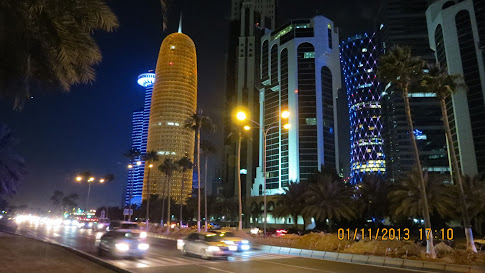
Doha, then, was a growing city, springing up from the surrounding desert, and a vibrant, multi-cultural place to be. It had some of the most spectacular modern architecture I've ever seen anywhere in the world: in my view it exceeds even Dubai, despite the existence there of the world's tallest building, the Burj Khalifa - and that is saying something.  The picture at the top of this piece I took one November evening on a waterfront stroll after work - there were similar views all over the place. Mixed in with all the modern stuff were smaller, traditional Arab houses and shops, and a big souk at one end of the bay that, like all such places, sold silks and carpets, spices of all kinds and scents, and cages full of animals and birds - it was a fascinating place, especially one guy I saw, strolling along with about four wives in tow, three or four laughing and chattering kids, all dressed in the full Arab robes, including a big curved knife stuck in his belt.  On his shoulder, watching everything closely with its beady eyes in a constantly swivelling head, sat a full grown falcon.  Apart from me, no-one batted an eyelid: perfectly normal behaviour.  I found it all fantastic.

The people at the bank were all perfectly friendly and helpful to we foreigners, even the few who were part of the Family that owned the bank and half the country.  I hadn't realised some of them worked there, until I bawled out one very beautiful girl, mid-twenties I suppose, who worked in the bank's Product Sales department, because she was playing about on her mobile phone when I was running a training course she was attending.  I told her if she was going to take thing seriously, the phone had to go off or be given to me immediately, as it was disturbing the other participants.  Failing that, then stop wasting all our time and leave the group.  She was as good as gold, apologised to us all, switched her phone off and placed it on my desk, and gave her full attention for the rest of the day's training. I told my boss about it over a drink in the hotel bar that evening, and he was horrified: her father was Sheikh Someone Or Other, part of the Qatari royal family and the bank chairman.  I'd essentially been bollocking Princess Anne, which as a working class council house kid I though was great.  We both expected fireworks the next day, (and I expected to be on the next flight out of there, in disgrace) but no-one ever mentioned it, and the girl was great for the rest of the course.  For me, it was an undoubted career highlight!

Even then, eight years away from the tournament, construction work was gathering pace, and there were metro lines being built to serve the football grounds under construction, the new airport was two-thirds finished, and work was beginning on an ambitious undersea tunnel between the airport and the downtown business area across the bay: it was supposed to have glass walls so you could look out at the fish and sharks and whatever else as you drove through it (or, more likely, were chauffered).  For all Doha's beauty and modernity, it was also like living and working in a huge building site.

----------------------------------------------------------

With this construction work came the influx of migrant workers that have been flooding the news for years.  Any article in any news outlet, newspaper, telly, internet, the lot, about Qatar's preparations for the tournament focuses on the issue of the country's record with human rights, slave labour and so on, at the expense of everything else.  There are accusations of migrant workers dying at work because of safety issues, about them being treated badly, housed in barracks, passports taken away from them, underpaid and so forth.  There may be some truth in some it: certainly, there have been deaths, but major construction programmes are invariably dangerous and accidents do happen.  There were deaths and serious injuries on the Channel Tunnel project, for instance. I can remember workers living in caravans beside the M25 motorway and elsewhere (Bob Geldof had stories of that in his autobiography, he was on the crew that built the M23/M25 intersection at Redhill), so living in barracks could be seen as an improvement on that.  Passport withholding, the so-called kefala problem, was an issue when I was there, being roundly condemned by the UN amongst others, and the practice was removed soon after I left.

I honestly believe a lot of it has been blown up out of all proportion, as has been the sportwashing outcry over the ownership of Manchester City, Newcastle United and other clubs with Middle Eastern ownership.  Similarly, complaints about human rights abuses have been exaggerated: I saw many work gangs in Doha, largely from places like India, Pakistan, Bangladesh and Nepal, all of them earning as much (or more) in a couple of months as they would in an entire year at home, and able to send most of it home to their families.  And I honestly can't remember seeing anyone looking sad or frightened or wishing they were elsewhere - but I did see a lot of cheerful faces and hear a lot of laughter, games of cricket taking place on closed roads during lunchbreaks, none of which appeared to me then or, on reflection, now, as evidence of people whose human rights were being abused.  

In any case, it seems to me "human rights" are difficult to categorise. and most (if not all) major, developed nations are guilty of abusing them.  I would suggest the human rights of the Native Americans counted for nothing when tribes were being wiped out across the USA and Canada in the 19th century (and those of their descendants dumped into poorly maintained  reservations still are).  The same could be said for the Aboriginal population (the First Nation) in Australia, the Maori in New Zealand, even those who were wiped out or enslaved in Colonial India.  This is without considering the victims of the Slave Trade from Africa, or the Amazonian Rainforest indigenous people still struggling to survive in modern Brazil.  Or the Palestinians bottled up in Gaza and the West Bank by an aggressive Israel supported by the US.  Or even people in Ukraine currently struggling to survive Putin's War.  I seriously can't see that Qatar's behaviour is either unique or much different - which is NOT to condone it.

There also many complaints about LGBTQ+ rights and fears that such people may find themselves in difficulty, or somehow persecuted because homosexuality is illegal in Qatar.  This again is an exaggeration: it's illegal in most Arab or Muslim countries, and frowned upon in many western countries, but that doesn't always lead to any kind of persecution. I believe a gay person is more likely to face problem in eastern European countries than in Qatar: in Poland, for instance, being gay is considered (and promoted thus by the government) to be an "ideology", and illness to be treated medically, for instance by electroshock therapy - I kid you not.  There is a loudspeaker van, funded by a nationalist organisation that receives financial support from the government, that spends the summer touring the country, spouting anti-gay propaganda (I prefer the term hate speech) - I've seen it a few times. Amid all the anti-Qatar stuff in the press, this is never mentioned, for some reason..... 

And this is why I find getting excited simply not possible.  It's not Qatar, or its human rights record. Or even the way it was awarded the tournament in the first place.   I can't get excited simply because of the reams and reams of hypocrisy, slanted press reports and simply  misrepresentative YouTube videos that have killed it for me.

------------------------------------------------------------

That said, I have no doubt I'll watch some of it.  I'm not sure which television channel(s) will be broadcasting it here in Poland, I still need to find that out. I'm betting that once it kicks off, it will be an entertaining few weeks of football, with its heroes and villains, the way it always is.  I expect my home country will make the quarter finals, then lose on penalties to Germany, as England tends to do a lot.  I also expect Poland will struggle to get out of its group, and if it does so will promptly lose to an unfancied surprise packet who will in turn be eliminated next game.

As to the winner: I suspect Argentina (Messi's Last Tournament is a hell of a driver for them) or Brazil.  Germany cannot be discounted (they never can be), nor France (provided they don't implode this year, as they have a tendency to do).  But I hope The Netherlands do it: they are possibly the Best Country Never To Have Won it, so it's about time they did.  They also have the remarkable Louis van Gaal coaching them (as he was when they lost the Final to an ascendant Spain in South Africa a few tournaments ago). He is 71 now, but as cantankerous and filled with self-belief as ever.  He is also suffering from Stage 4 prostate cancer, meaning he has to use a catheter (under his track suit when he's coaching) and increasingly nowadays a wheelchair.  Whatever happens, this will be his swansong.

And what a wonderful goodbye it would be! 


Monday, 24 October 2022

The Party's over - please!


I'm going to place a bit of a caveat on this piece, namely that I'm not a political scientist, have never held membership of any political party, and due to my non-resident status find myself politically persona non grata - more on this later. So the comments and views that follow are certainly personal, and not influenced by anything except my own experiences and a contemplation of poilitics in Britain. As I wrote in a previous blog, politics is top of my list of inventions I can do without - but has always (and still does) hold an unheallhy fascination for me.


For avoidance of doubt, I started voting in the 1970s, when the voting age was cut to 18, and have always taken it as a serious public duty. I have always taken note of the policy plans announced by all the major parties (and some of the minor ones) in the run-up to an election, and tried to vote for the party that in my view seemed the best fit for what my personal and, later, family needs were. My parents and sisters were never overtly political, never watched any party political broadcasts (they considered them at best boring and at worst just another pack of lies - and were probably accurate in that) nor political discussion programs like the BBC's once excellent Question Time, for the same reasons. So they never tried to influence my vote, and frankly I'm not sure they even cared who I voted for. In all honesty, my vote was generally meaningless anyway: through an accident of birth I always lived in constituencies that invariably voted for the same party, safe seats all. My vote simply increased or decreased the Member's majority by one.


Taking that methodology (and sorry, I can't think of a better word - it's not a favourite of mine as it reminds me of work...) at least gave me the chance to understand a bit more than most about what the parties stood for at any given election. It also meant that, over the years, until moving abroad and losing my voting rights, I dutifully put a cross against the names of candidates representing the Conservative Party, the Labour Party, the Liberal Party, the Social Democratic Party, and the Liberal Democrats. I also voted for the Green Party once in a local election. I never met a candidate, was never door-stepped or stopped in the street, and only once met my MP.


But today, I'm only writing about one party: the Conservative and Unionist Party.


-------------------------------------------------------------


The Tories have always considered themselves the only party fit to govern. Every time there is an election, be it local or general, one of their major selling points is still that they are "the natural party of Government". They also brag about being "the biggest and the best, most successful political Party in the history of the world". Clearly, then, they are quite happy to blow their own trumpet. The first boast seems to me hubristic in the extreme and is no longer anywhere near true, while the second may contain a grain of truth (although frankly I can't be bothered to trawl through a couple of hundred years' worth of electoral results to prove it one way or the other). Even if it is a statistically accurate statement, in my view it has little value now, and indeed has not been the case for most of my voting lifetime.


In my childhood, the party certainly seemed that way. The leaders, at least in my memory, MacMillan and Home, certainly carried a gravitas that Harold Wilson could never match. When they said something, in their clipped public school accents, people tended to listen, but that may simply be a distortion of the truth due to my then young age and my working class upbringing. My parents were both born during World War One, working class country people who met while employed as a gardener and a housemaid in service to the de L'Isle family at Chiddingstone Castle in Kent. So they insisted that, like it or not (and I think mostly not) people of our stock should defer to people of MacMillan's and Home's stock: the class system they had grown up through, though damaged by the two Wars, was still prevalent. At least MacMillan and Home and their various senior Ministers looked like statesmen, in their pinstriped suits, bowler hats and so forth, and gave the impression of knowing what they were doing and caring for the entire electorate. Going back through the history books now, that clearly was not always the case.


-------------------------------------------------------------------------


But to me, they seem to have been a bit of a Last Hurrah. Look at the line of succession.


Ted Heath presided over a sliding economy and months of industrial strife that led to power cuts, train cuts and postal strikes: I can remember in my first job, at a venerable old stockbrokerage in the City, working by candlelight in positively Dickensian conditions as a result, and spending days cycling around my home town in the cold and rain delivering company mail to our clients in the area. He also presided over the "once in lifetime referendum" - now, where have I heard THAT before? - that took Britain into the European Economic Community, thereby releasing forces that have been ripping apart both the party and the country ever since.


Margaret Thatcher took on the unions and won, destroying the coal, steel and car manufacturing industries, much of northern England, Wales and Scotland in the process. In a bid to create a "share and house owning democracy" - the ancestor of Levelling Up? - she de-regulated the Financial Services industry thus unleashing a vicious winner-take-all City culture of Get Rich Quick chicanery that changed the face of banking and finance forever, and broke up state-run service industries like the railways, post office, telecommunications, gas and electric provision to provide the service choices she championed but at the cost of a much less efficient and worse value for money proposition. Finally, she led a nationwide sell-off of council houses - and my mum benefitted from that, buying a big, three bed end of terrace for virtually nothing as a tenant of 40 years - but failed to guarantee their replacement by new-builds that is at the heart of the current housing crisis. In foreign policy, she managed to upset most of the other EU nations (the EEC had grown a lot by the time she took it on) by demanding and getting a rebate on Britain's share of the bloc's funding that still failed to please the increasingly vocal Eurosceptics within the Party, and successfully waged war against Argentina, who had had the temerity to invade the British dependency of the Falkland Islands. Over the period of her premiership, thousands of lives were lost or ruined, physically and financially, as a direct result of her actions. The Tory Party loved her. And still do.


John Major, her replacement as party leader and Prime Minister, led them to a fourth successive election victory in 1992, but remained a disappointing premier. As both a Foreign Secretary and Chancellor under Thatcher, much had been expected of him, and although enjoying some limited success in healing some of the societal divisions she bequeathed him, he failed to satisfy either the party or, ultimately, the country. The Citizens Charter he introduced was a partially successful attempt to create a fairer society by providing more open and accountable, results driven public services. It lasted through to 2010 before being quietly dropped. He abolished the much hated Thatcherite Poll Tax with a (quite similar) Community Charge, and managed to commit troops to the First Gulf war that followed Iraq's invasion of Kuwait. He also withdrew sterling from the EU's Exchange Rate Mechanism (that was meant to stabilise currency rates in preparation for the euro single currency introduction) after speculators including George Soros made billions of pounds by shorting sterling and causing its value to crash on Black Wednesday in September 1992. He also led our negotiations of the Maastricht Treaty that defined the governing structures of today's European Union, succeeding in agreeing some opt-out provisions for Britain, including its non-membership of the Single Currency. It was still not enough for the Eurosceptics, whose continued agitation eventually led, indirectly, to his resignation after losing the 1997 election to Tony Blair's Labour Party.


----------------------------------------------------


In Opposition, Michael Howard, William Hague and Iain Duncan-Smith all tried to bring some sense and cohesion to an increasingly fractured Conservative Party and provide a strong opponent to a Labour Party that at times struggled to delivers on its own promises - especially after the second Gulf War, in the wake of the WTC atrocity in New York in 2001, that led to the downfall of Saddam Hussein in Iraq, and the ill-fated Arab Spring (a complete misnomer since the series of uprisings in various Gulf States ran for two years between 2010 and 2012) in search of democracy that instead has led to civil war, failed states and much bloodshed at the hands of a global Islamic terrorist movement.


None of them made much of an impression, and the party continued to fragment, with opposition to EU membership continuing to gnaw away, and strengthen its hold. Not a single leader, whether in government or opposition, seemed able or willing to confront and resolve the problem. All complained bitterly about it, but no-one did anything.


---------------------------------------------------------


David Cameron, Old Etonian, Oxford educated, son of a leading stockbroker and the recipient of an impressive income from the type of Panamanian offshore trust fund - perfectly legally set up and administered - that in his term of office suddenly became a political Hot Potato that prompted public outrage and EU-wide legislation took over leadership in 2005 and led them to power in 2010 in coalition with the LibDems. It never really worked, for the simple reason that British politics in general, and the Conservative Party in particular, do not understand coalition government because it inevitably undermines their own authority. It's all me, me, me, and this effort was no different, with the major cabinet positions taken by Tories and LibDem policies generally watered down or dropped. It limped along through its term to 2015, hamstrung somewhat by the global recession after the failure of Lehman Bros that forced a rigid austerity economy to keep government spending under control and taxes higher than any Tory likes. Bits of legislation came through, including legalizing gay marriage, cuts to the defence budget that have harmed Britain's defence capability ever since, and measures that intended (but failed) to reduce net immigration. He also held a referendum on Scottish independence that he won and Scotland remains part of the UK despite a hefty (and growing) proportion of Scots wanting to break away. For the 2015 election he promised an "advisory referendum" on Britain's EU membership and duly won a significant majority and all but wiped out the pro-EU LibDems in parliament.


The Brexit referendum was a brutal affair, with Cameron's Remain campaign pitiful in comparison to the Leave campaign and allowed the Eurosceptics in the Party to have their day.. It resulted in a shock defeat, a narrow vote in favour of leaving the Union that split the Party. Cameron did the cowardly thing and resigned within a couple of hours of the result being announced. Everything that has gone wrong in both the party and country can be laid squarely at his door. He faced the same Eurosceptic agitation as every other Tory leader since Heath, and like every other Tory leader since Heath failed to deal with it.


Theresa May reluctantly took over as leader and PM, and struggled to deliver a Brexit that would not be too damaging, but, as usual, was dogged throughout her premiership by the increasingly influential Eurosceptics. She came to power with a decent majority, and squandered it in an unnecessary snap election. government business was dominated by the tangled negotiations and ultimately came up with a package that would have done the job but was voted down. With it went her premiership as she resigned.


Boris Johnson, arch-Brexiteer, another Old Etonian and contemporary of Cameron and Oxford, ex-Mayor of London and formerly employed by the Daily Telegraph (then the Conservative Party's newspaper of choice) as their Brussels correspondent where he spent his time making up stories (mostly untrue) about the EU and EU regulations, was overwhelmingly elected as party leader on the promise of having an "oven baked exit deal ready" that could bring the country out immediately, When put to the vote, in a very truncated debate to force it through, the Opposition parties demanded more time to go through it and ask questions. Johnson's answer was prorogue parliament (i.e. terminate the session), an action widely considered illegal, and hold yet another General Election. He won a record breaking 80 seat majority that allowed him to basically do as he pleased. The deal was signed and Britain left the EU - but within weeks it became clear that parts of the Treaty were not working so Johnson unilaterally decided to ignore them and re-negotiate: the clear inference being that he had failed to understand big chunks of his own agreement. The arguments continue to this day.


Along came Covid. Johnson's government created a massive program of public spending, essentially unfunded, to support the economy and save people's jobs, and spent further billions in a vaccine rollout that over a two year period did indeed save millions of jobs, and vaccinate and boost most of the population to bring the pandemic under control - but at the cost of spiralling government debt. Then the shit hit the fan, and stories, illustrated of course, came out showing that he and many of his close associates, fellow Member and office staff had frequently broken their onw lockdown rules. Reports emerged of he and his staff drinking beer and wine and scoffing sausage rolls in garden parties at a time when the rest of the public were not allowed to meet together in more than direct family groups, nor make hospital visits to relatives in ICUs suffering from Covid, and worst of all attending the funerals of parents and children who had died. Johnson denied doing anything wrong, denied knowing about the parties - until photos of him standing on a chair raising a toast while surrounded by his acolytes - and was investigated by the Metropolitan Police. Confidence in him evaporated amongst his own MPs (though oddly not within the party itself) and he was forced from office, kicking and screaming and crowing about his own (often questionable) achievements.


----------------------------------------------------------------------------


Incredibly, it got worse. A drawn our election process that limped through this summer brought in Liz Truss as the new Leader. She was of course a Johnson ally and a fervent Brexiteer, and tried to bury her past as a LibDem activist and voting Remain in the 2016 Referendum. She went off to Balmoral and was invited by the Queen to form a Government. By the time she had filled her Cabinet the next day the Queen had passed away. The country and government business essentially ground to a halt while the State Funeral was planned and took place, and King Charles officially ascended to the throne. Truss and her incompetent Chancellor then presented a "fiscal event" - for which read, mini-budget - that pledged another forty-odd billion pounds of (unfunded) tax cuts and government borrowing that lacked any kind of validation by the government's own Office of Fiscal Responsibility. It went down like a lead balloon, outside her inner circle and perhaps the 80,000 Party Members who had voted her into the job. The pound crashed. So did the bond markets. There was criticism from the IMF and the World Bank. The Chancellor was called back from a meeting in Washington and sacked. Her new Chancellor reversed the majority of the pledges made in the mini-budget and made it clear that he would run the economy his way - i.e. professionally. Finally, the Home Secretary foolishly sent an official document from her own email address, rather then her office one, and was sacked for a breach of protocol, and a blazing row with Truss. The confidence in her premiership evaporated and she resigned on her 45th day in office - the shortest ever period, and probably the worst PM in history. She will not be missed. As one wag commented: in 45 days she has buried the Queen, the economy and the Tory party.

So: another Leadership contest...... the former Chancellor, who narrowly lost out to Truss, is as I write well in front and likely to take over today or tomorrow. The current Leader of the House, who finished third last time, is lagging way behind but insisting she will still win. And Incredibly, Boris Johnson managed to cobble together over a hundred votes amongst his loyalists, without even declaring he would run for the job. Surprisingly he stood down late last night as it became clear that a high percentage of his own MPs would not support him if he regained the job - governing would be too much like hard work for the lazy git. For perhaps the first time in his life he did the decent thing and walked away (for now, at least....).


------------------------------------------------------------------


As things stand, the Conservative and Unionist party, a.k.a. the Caring Conservatives or, more popularly these days The Nasty Party, will remain in government with its third leader and Prime Minister since the spring, only one of whom had a public mandate via a general election. No-one within the party is talking about calling another general election because they would probably get wiped out at the polls: and rightly so after the incompetence and lack of leadership stretching back 50 years.


Now I accept that some of their leaders, notably Thatcher and perhaps Major did some good stuff that benefitted ordinary people like you and me, at least temporarily, but they too left chaos and inequality behind as part of their legacies that should not be ignored. The last four Tory Prime Ministers have been terrible, each one far worse than its predecessor, and the pain felt by the electorate is worse now than it has been since the 1970s when Thatcher was merrily destroying British industry: it took a generation to recover from that and all the gains and promises that were there pre-Referendum have been washed away by the Brexit fiasco. Britain is back to hard times, facing a health service in crisis (again), rising costs and unemployment (again), a still fractured transport system, a housing shortage and High Streets containing more For Sale boards in shop windows than goods. After 12 years in power, one way or another, it is impossible to blame it on anyone but themselves - but of course they try to do that.


The party is at a crossroads. It HAS to change. It HAS to put the electorate before personal gain and clinging to power at any cost. It HAS to govern, prudently and with vision, and forget all about this "we're better off under the Conservative Party" nonsense, because that patently is not the case. The new leader, who will simply be the best of a bad bunch (as an aside, I have never seen a parliament of so little talent, on all sides, than the current one: the Tories are not the only Party to suffer from internal crises and incompetence) rather than a statesman in waiting must first re-unite a party riven by internal struggles and competing ideologies around a common agenda and then KEEP it that way. It MUST govern for everybody, without favour.


It would be nice if the new government gave a thought to its ex-pat British citizens too, because we have families, children and grandchildren, back home and we care about them and our country just as much, wherever we may live. Right now, we do not count in ny policy discussion. Some, but not all, of us managed to get a postal vote for the Brexit Referendum (the mechanics of doing that were simple but never publicised) so perhaps two million of us were unable to have our say. That privilege was not extended to subsequent General Elections. We are disenfranchised. When the Queen died, no book of condolence was opened at the British Embassy here in Warsaw, and enquiries to them have remained unanswered nearly three months later. I have heard from ex-pats elsewhere who have had similar experiences. This is simply wrong: we are still British Citizens (it says so on our passports) and still pay tax into the Treasury's coffers at source from our pension arrangements. It would be reasonable to have a small say in how they spend the money....


I don't believe the Party is capable of doing any of that. I can see it limping on for another couple of years, hoping to turn a corner, before the next election must be held. Depending on how it performs in that time, it may not be completely wiped out, as it probably would be were the poll held this week. The longer it drags on the more damage will be done to the country, and it may take a generation or two to repair..


It makes very sad. And more than a little angry.


Thursday, 20 October 2022

Inventions: the Good and the Bad.


Funny thing, progress. Done right, it makes all our lives easier, more productive, more rewarding - both financially and mentally - and gives the entire human development a kick forward. Done badly and it can lead to disaster and regression. It's all subjective, of course, and I have no doubt everyone has a different view about what's been good and bad for both them and the rest of us.

For what it's worth, here is a little list of 8 developments that could come under the label (perhaps misleading in itself) of inventions that I could quite happily live without as in my view they are more trouble than they are worth, plus an even smaller list of similar things that I simply could not. And why....

Remember: it's all subjective and I'm guessing few people, if any, would agree with me. So - here goes:

------------------------------------------------

Inventions I could do without:

Politics and Religion.  A biggy to start with, and calling it an invention is perhaps stretching things - but someone, somewhen, somewhere must have had the original ideas. Now I know some people would argue that, without either, human society would not be able to properly function - the obvious question here being what, precisely, is meant by "function". An advanced (er.....definition please!) society would probably insist that both activities - for want of a better term - are Must Haves to enable people to co-exist happily in an organised and peaceful manner, helping each other when life gets tough (as it always does) and draw comfort when facing the worst of all human problems: severe illness and death. Further, politics is needed to bring definition to right and wrong, to maintain order in society and bring order to chaos. Native tribes in the Amazonian jungle and elsewhere that have been decimated and had their lands appropriated in the name of progress may well disagree.

All of which would be perfectly fine if it wasn't for the fact that more people have died, or been injured, or lost everything they value in life - homes, health, money, families - in the name of politics and/or religion than for any other reason. Whether the Crusades, the Spanish Inquisition, the two World Wars, Vietnam, not to mention the present slaughter in Syria, Yemen and Ukraine, Thatcherism, Brexit, Trumpism or Trussonomics - which thankfully has died an early death (as should her dreadful premiership) - they are all nonsense. I have no time for either (but to my despair cannot help myself from becoming terribly wound up about both).

Social Media.  For all the blather from Zuckerberg and Dorsey and Musk and all the other alleged idealists who have created this monster, Social Media is not the panacea for all ills they claim it to be. Sure, linking people up through a selection of on-line platforms to discuss stuff, for ex-pats of whatever nationality to stay in touch with Friends and Family in their homelands, swap recipes and cute pictures of kids and pets, birthday and Christmas greetings, is all very well and good. But when those same platforms act as a means for spreading all kinds of hate, from teenage girls body shaming to terrorist recruitment tool, via racism, anti-gay propaganda and political lies and deceit of all shades, then I'm afraid it loses a lot of its appeal to me. The platforms seem incapable of policing themselves, content to say all the right things about cleaning house and blocking "bad" users, then doing no such thing. Politicians talk about legislating to force this but, again, seem reluctant to do so, perhaps because it would make their own lives more difficult by making it harder for them to distribute their bullshit to their electorate. The horse has bolted through the stable door left gaping when this beast was invented, and for good or ill we are stuck with it.

E-mail. When I first got married, getting on for 50 years ago now, an uncle who lived in Canada inducted me into the family letter writing society. We corresponded with each other - my uncle and I, my mum, my sisters, my second cousin in Lancashire, and first cousin in Australia - through a circle of mostly air-mail letters. We all wrote them using proper fountain pens (none of this Bic ballpoint rubbish) and swapped news and gossip and exam results, births and deaths, all the usual stuff people talk about. I can remember the excitement when a letter postmarked Ottawa or Sydney or Warrington dropped through my letter box. It all died, sadly, partly as some of the older participants passed away, but also with the advent of e-mail. This meant that your gossipy epistle would be received immediately and a reply possibly come within minutes rather than weeks, and you would be able to read it easily in Times New Roman or Sans Serrif font on your computer screen rather than have to decipher sometimes poor handwriting - I know for a fact my own has deteriorated terribly since I started doing everything on a keyboard and screen rather than pen or paper. I tried to revive it last Christmas by enclosing a handwritten letter with the cards, inviting them to write back, by hand...... I received not a single reply that way, just a few e-mails...... I find that very sad: what used to be an art-form dying out. I'm sure the convenience and speed that e-mail brings is simply not worth it.

The Internet. Which is in a sense at least partly to blame for the previous two inventions, as neither would be possible without it. The World Wide Web is another those "fantastic on paper" advances that very quickly outgrew the original aims and visions to become an all-conquering uncontrolled force for good and evil in equal measure. It changed the way humanity interacts, does its business, communicates, shops, books holidays and tickets for trains and boats and planes and every other form of transport and trading. It controls airspace and sealane traffic and finds you the best route from A to B without spreading a bloody great map across your windscreen. It provide a means of taking thousands of photos and movies, most of which will be crap, and a means of storing them instantly, safely and mostly for free. It also guides missiles unerringly to their targets hundreds, perhaps thousands, of miles away, and shares information on troop movements, where in the delivery chain the tv you've just bought on-line is in real-time, and where is the best place to buy a pizza at your destination before you even leave h ome. And if it breaks down, for whatever reason, whether through conflict, power cut or natural disaster, there is panic....... We are too reliant on it, the old skills like map reading and journey planning and shopping declining, as indeed are attention spans. This is called progress, apparently.

Telly. Ah, the good old television. Ubiquitous for 70-odd years. Every home should have one (at least: in America and increasingly Europe that's just your starter). One channel, then two, then three,,,, Now literally hundreds beaming onto a screen near you, the vast majority of which you never even look at. News channels, drama channels, true life and entertainment channels. Comedy channels, car channels, cookery channels. Kid's channels. Shopping channels. Sport channels by the dozen. Free to air and Pay On Demand and Subscription. Movies old and new. Gold channels (for which read old 1970s and 80s repeats that appear more dated by the day). The Parliamentary Channel. God TV. Background noise, mostly, with pictures, while we eat, do homework or work from home. Talentless idiots with celebrity status whichever way you look. Nothing has had a bigger, more detrimental, effect on attention spans, especially those of children - apart from the internet and social media. The biggest conversation killer and family disruptor ever invented. Give me radio any day of the week.

Fossil fuels. They are killing the planet, and us with it, unless we wean ourselves off them, with a no-return tipping point set to be reached within my lifetime. We've used coal for hundreds of years to heat our homes and cook, and oil, both refined and unrefined, for cooking and power, in particular refined as petrol to run the internal combustion engines that power cars and trucks and buses and motor bikes and ships great and small the whole world over. The more power we generate, the more power sources we develop, the more power we insist we need. It's a vicious circle and we as a species are struggling to break out of it. Granted, it's only recently, within less than a century, that we have come to understand how much damage the gases produced from fossil fuels is actually doing to our atmosphere and hence our planet and our health, but despite this new-found knowledge we seem unable to leave the stuff in the ground. More needs to be done in educating ourselves about what we, as individuals, can do to help, and how we can force our politicians to make the difficult choices that are needed on the larger scale - something many of them are conspicuously not doing. It's not (quite) too late, but the clock is ticking and time passing very quickly.

Plastics. If Fossil Fuel was a terrible (but unrecognised thus) invention, plastic is arguably worse. It's another recent invention, but an estimated 9.2 billion tonnes of the stuff manufactured between 1950 and 2017 - add on a billion or so more to cover the past few years.(400 million in 2020 alone). Most of it ends up in land-fill sites and in the seas as trash. Unless specifically re-cycled or incinerated, the stuff takes years (no-one is sure exactly how many) to break down naturally. Of all the plastics made so far, just 14% has been incinerated, and a less than 10% re-cycled...... Just think about that for a moment.....

Micro plastics (tiny, microscopic balls of the stuff) are now finding their way into our food, via the meat and plant crops we are eating. No-one knows what the long term effects of that are going to be - I imagine not good. It's used in food packaging, soft drink bottles, consumer goods, clothing and footwear, cars and household goods. It's dangerous stuff: seas and rivers, lakes and reservoirs are already choked up with it all over the world and efforts to clean them never seem to keep pace with the inflow of yet more.

Smart phones. Mobiles phones have only been around for 25 years or so, and smart phones for not much more than 15. And yet they dominate communication all over the place - I only know of two homes that still have (and use) a landline, and they are my elder sisters' (both in their 80s, new technology being beyond them). The original mobiles, so-called feature phones (or dumb phones) were simple enough, good for voice calls and text messaging, but not much else. The better ones had rudimentary cameras and radios for entertainment. That was about it. Then Apple brought out the iPhone, and suddenly you didn't need a keyboard with buttons and letters to type with: they were on QWERTY keyboards on-screen. The cameras were better, the radios replaced by slots to hold memory cards with your own choice of music saved on them. They even came with calculators and calendars and notebooks and internet connectivity, and access to apps that gave you, eventually, pretty much any service or tool you wanted. Essentially, no matter which one of dozens of manufacturers' model you own, you now have a combination telephone, global atlas, web browser with a full set of productivity tools, a sound system and tv and games console in one package that fits in your pocket. It's a technological miracle and a pain in the arse, because unless you switch the thing off you are "online", "in touch" constantly, 24/7. If the telly is the conversation killer, then the mobile phone can be the life-killer (unless you use it in a disciplined manner - which most people don't, especially kids).

------------------------------------------

And others I couldn't:


The Internet. Yes, yes, I know I said I wish it had never been invented and I stand by that. But like it or not, the web is here to stay so I have to accept that and use it to the best of my ability. For all its faults - and I only mentioned a couple: I'm sure you will have other ideas - it also has its good points that have made it a permanent fixture in all our lives. In health care, it enables prescriptions to be renewed by phone and held online at my local pharmacy without my having to queue up at the doctor's surgery: he can spend his time helping patients who need help more than I do and I can collect my meds at my leaisure. It also enables teams of surgeons in different locations to co-operate on major, complex and ground-breaking surgery by web-cam. In commerce, it allows shopping on line at chain-store websites with door to door delivery: handy for someone living along and unable to get to the store, or simply too lazy to do so. Similarly with luxury goods, clothing, books and whole universe of other commodities. It enables me to research, write and publish this blog, and keep up with the news that interests me, at any time, in real-time, anywhere in the world. I could do the same with my books, if I could only find the energy to finish the bloody things, and finish setting up my Amazon Kindle publishing account.....

Streaming services and internet radio. Another internet innovation with faults but still, for me, priceless. I know the arguments about platforms like Spotify and YouTube Music and Tidal and all the rest ripping off artists on a scale never before encountered, and I truly sympathise with content creators because they are absolutely right. I know too that the free versions with their adverts popping up every so often, sometimes in the middle of an intricate and superb piece of music, or, worse, freezing until you log in again, is a complete pain in the arse, and that I can stop it happening by subscribing. But the thing is, I don't actually listen to them all the time, and when I do it might be Spotify for an hour so, then YouTube Music for while, then a burst of Scala Radio and back to Spotify again. Subscribing to them all is, for me, an expense I can't justify, so I happily put up with breaks. Internet radio is similar and the only way I can listen in to Radio 2, Classic fm, Virgin, Scala Radio or hundreds of other stations scattered around the world from the comfort of my armchair in Warsaw. It's great. Then you have Netflix and Disney and Apple tv and all the others that produce often superb content, 24/7 to a telly or computer near you. Given the paucity and repetition of content on the majority of the channels on my Orange and Canal+ satellite package, these streamers too are a boon (though an expensive one).

Supermarkets. Even without online shopping, these beasts have changed the way we shop, and I'm not sure if that is entirely a Good Thing. In my home town, as a kid back in the 1960s, there were no supermarkets as we would recognise them today. But in the High Street, fresh meat and sausages, freshly cut on site from carcasses hanging in full view of we shoppers, could be bought in two butcher's shops. They even offered a delivery service: no DHL or UPS for them, instead there was a lad, a schoolboy, who was entrusted with a big heavy bike with a massive basket welded to the handlebars that was filled with packages wrapped in greaseproof paper (no plastics in sight...) to be ridden around town to the customers' houses. I did it a couple of days, when the lad (a good friend of mine as it happened) was unwell, and it was bloody hard work.

There was also a fishmonger and a couple of greengrocers for your fruit and veg (my dad grew all ours in the garden), a couple of bakeries for fresh bread, cakes and meat pies and an ordinary grocery store for things like tea and coffee, flour, sugar, washing powder and all the other household stuff. It was the closest we had at the time to a supermarket, but on a very small scale. In the 70s the International Stores and the Co-op came to town, opening places that were much closer to today's supermarkets, and the little stores, the butchers and so on, as small family businesses, were unable to   compete and over time all closed. It's a common story and has happened all over the world.


I could just as easily place supermarkets in the Could Do Without section, because I always find shopping at a small store - and there are many scattered around, if you want to seek them out, especially in Poland - much more rewarding, and generally lower prices and frequently fresher and better quality produce too. But, to be realistic, going shopping every day is a bit of chore (though one that I still have) and it's often easier and cheaper, when you count the special 2 for 1 offers, to do a big weekend shop and top up as needed. So we need supermarkets: again, like it or not, they are here to stay.


Two more books.

  This has been a good start to the year for my reading. My “To Read” pile grew by half a dozen titles that I had as Christmas gifts. There ...